
KIUrious
From Deadlock to Dialogue: A New Phase in Hungarian–Ukrainian Relations?
After years of tensions over the rights of the Hungarian minority in the southwestern Ukrainian region of Transcarpathia, Budapest and Kyiv reached an agreement in early June. Shortly afterwards, the European Union opened the first accession negotiation cluster with Ukraine. In this interview, KIU Fellow Katalin Kovály explains the background to the long-running dispute, what exactly was agreed, and what it could mean for bilateral relations between the two countries.
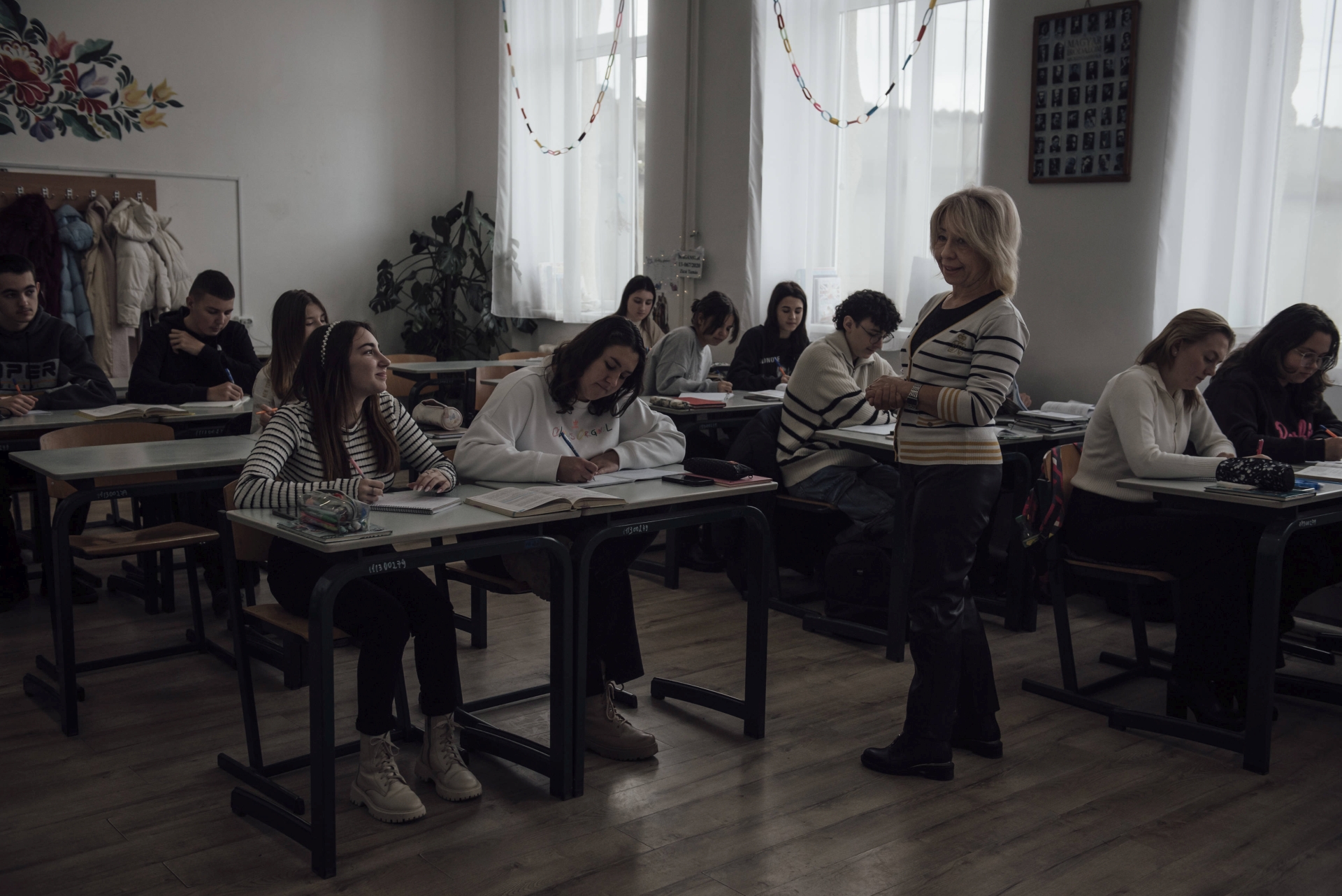
Physics lessons at a school for Hungarian minority pupils. Classes and books are in Hungarian. Berehove, 26 January 2024. (IMAGO/Le Pictorium)
Hungary’s new Prime Minister, Péter Magyar, made the resolution of minority rights issues in Ukraine a condition for Hungary’s approval of the start of EU accession talks with Kyiv. What is at the heart of the conflict?
The disputes centres on a long-standing disagreement over how to balance the promotion of the state language with the protection of minority rights.
In Ukraine, language and education policy reforms introduced after 2014 were primarily aimed at reducing the use of Russian. However, they also affected other minority groups, including the Hungarian community. As the role of Ukrainian as the state language was strengthened, opportunities for minority language use in education and public life became more limited.
In recent years, the situation of the Hungarian minority and the issue of minority rights became increasingly politicised amid the deteriorating relations between Budapest and Kyiv. Citing these language and education policy measures, such as the F2017 Law on Education or the 2019 Law on Language, the Hungarian government for years slowed down high-level EU–Ukraine consultations. The dispute placed a significant burden on bilateral relations for nearly a decade, as the positions of the two sides remained far apart, contributing to its protracted nature.
At the same time, Hungary refused to provide military assistance to Ukraine in its war against Russia. In practice, however, its policy was more nuanced. Following the outbreak of the full-scale war, Hungary cooperated in facilitating the entry of Ukrainian citizens across the Hungarian border, received tens of thousands of refugees, provided humanitarian assistance to Ukraine, and supported EU sanctions against Russia, albeit while frequently criticising them. This duality — combining conflictual rhetoric with a more constructive policy in practice — characterised Hungary’s approach throughout the period, including in 2022, when Hungary did not oppose Ukraine’s acquisition of EU candidate status. Following Péter Magyar’s rise to power, negotiations between Hungary and Ukraine that had seen progress for years gained new impetus.
In early June, Hungary and Ukraine announced an agreement aimed at resolving their long-standing dispute over minority rights. What are the key elements of this agreement, and what does it mean for bilateral relations and Ukraine's EU accession process?
It is important to note that the recent agreement is fundamentally not about granting new rights, but rather about restoring rights that had previously existed. While the precise details of the agreement have not yet been made public, it is known that the negotiations were based on the eleven-point proposal originally formulated by the Orbán government. Discussions on these issues have been ongoing since 2024, when the eleven points were incorporated into Ukraine’s EU accession negotiating framework.
There had already been some progress on minority rights in previous years, including changes to legislation affecting Hungarian-language education. However, these steps did not improve bilateral relations at the time. Nevertheless, several issues remained unresolved until recently and have now reportedly been addressed. These concern Hungarian-language education, language use in schools and public administration, the free use of Hungarian national symbols, and various cultural and political rights. For example, accordingto information released by the Hungarian government, it has been guaranteed that in municipalities where Hungarians constitute at least 10 per cent of the population, provisions enabling bilingual signage, the use of national symbols, and the use of Hungarian at cultural and sporting events will automatically apply.
However, the relevant demographic thresholds are based on data from the last Ukrainian census conducted in 2001. This is advantageous for the Hungarian minority, whose numbers have been declining. According to the latest official census data, approximately 150,000 Hungarians lived in Transcarpathia, representing only around 0.3 per cent of Ukraine’s total population. Although only estimates are available today, the size of the community is around 100,000.
Importantly, the European Union has made the implementation of minority rights commitments part of Ukraine’s accession process, requiring its Action Plan for the Rights of National Minorities to reflect the outcomes of Hungarian-Ukrainian relations. This made it possible to open the first negotiation cluster for Ukraine on 15 June 2026. Furthermore these commitments must be incorporated into Ukrainian legislation and adopted by the Verkhovna Rada before they can take full legal effect.
With this agreement, one of the main obstacles to opening Ukraine’s EU accession negotiations has been removed. Does this mark the resolution of a long-standing bilateral conflict, or do fundamental tensions between Hungary and Ukraine remain?
Péter Magyar and the Tisza Party have adopted a noticeably different rhetoric from that of the previous Fidesz government. While the Fidesz administration also supported Ukraine’s territorial integrity, Tisza has been more explicit in describing Russia as the aggressor and more consistent in condemning Russian attacks against Ukraine.
In recent days, the Magyar government lifted its previous blocking position regarding the European Peace Facility, one of the European Union’s key instruments for financing military assistance to Ukraine. The Orbán administration had maintained this position for nearly two years. At the same time, Péter Magyar does not support a fast-tracked accession process for Ukraine’s membership in the European Union. According to his position, this would be unfair to Western Balkan candidate countries, such as Albania and Serbia, which have been awaiting membership for a considerably longer period.
In my view, neither country has an interest in maintaining strained relations. The new agreement may open a new chapter in Ukrainian–Hungarian ties, which have reached a historic low in recent years. Following his election, Péter Magyar stated that he wished to resolve outstanding disputes with Hungary’s neighbouring countries, including Ukraine, and to pursue a constructive neighbourhood policy. A similar willingness to normalise relations is also visible on the Ukrainian side.
From the perspective of the Hungarian community in Transcarpathia, it is also a positive development if Ukraine and Hungary are able to normalise their relations and replace conflict with constructive dialogue. Nevertheless, I would regard the current agreement as a significant step forward rather than the definitive resolution of all bilateral disputes. Although important progress has been made in the field of minority rights, differing positions may still emerge in the future regarding subsequent stages of Ukraine’s European integration and certain security-related issues.
Katalin Kovály is a Research Fellow at the HUN-REN Geographical Institute in Budapest and Assistant Professor at Ferenc Rákóczi II Transcarpathian Hungarian University. Her work focuses on social and economic geography, particularly in Transcarpathia and on transnational processes in the Ukrainian–Hungarian border region.