

Lecture Series Summer Semester 2026
Introduction
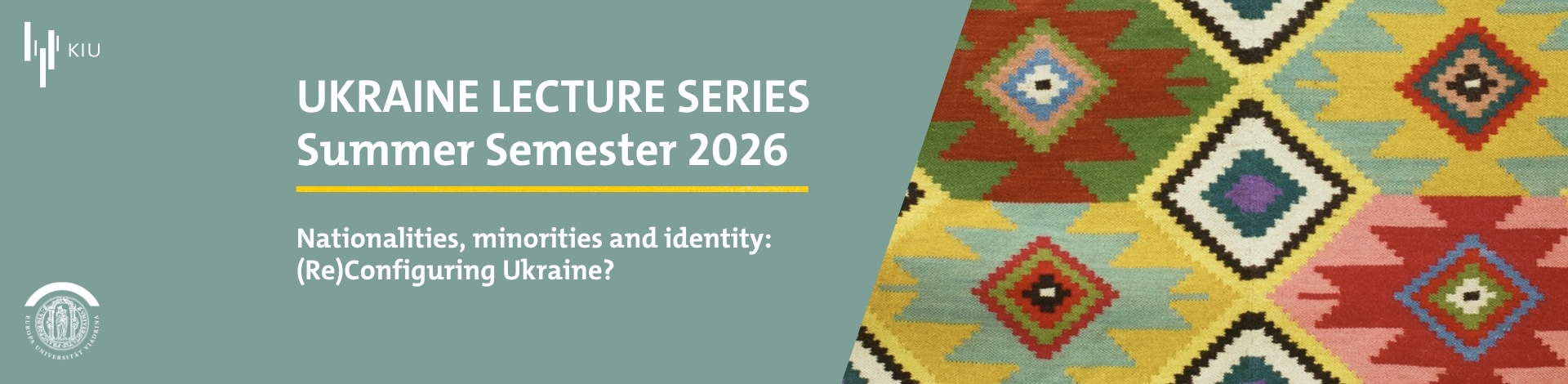
Screenshot / ornek-crimea.com
Minorities, nationalities, and identities constitute a vital element of Ukraine’s social and cultural fabric. The country comprises more than 100 ethnic groups, numerous national minorities, and three officially recognised indigenous peoples. Communities such as Crimean Tatars, Roma and Sinti, Hungarians, Romanians, and Jews contribute significantly to Ukraine’s multilingual and multicultural landscape. Since 2014, and particularly after Russia’s full-scale invasion in 2022, minority groups have confronted increasing challenges related to displacement, security, and the safeguarding of human, social, and cultural rights. In territories under temporary Russian occupation, communities including the Crimean Tatars as well as the North Azovian Urums and Roumeans—whose 76 compact settlements in eastern Ukraine are now entirely occupied—face systematic persecution and violence. Many minorities struggle with the loss of homeland, the endangerment of their languages, and threats to their cultural heritage, while Roma communities experience continued marginalisation and persistent antiziganism.
In this lecture series, we will examine minorities, nationalities, and collective identity in Ukraine in both historical and contemporary perspectives. We will focus on the multifaceted impacts of culture, diversity, heterogeneity, resistance, self-empowerment, and transnational integration on Ukrainian identity. It will analyse how Russia’s invasion has further transformed this identity, revealing both the diversity of Ukrainian society and the resilience of a collective identity grounded in self-determination.
Programme
Ukraine Lecture Series ‘Nationalities, minorities and identity: (Re)Configuring Ukraine?’
When: Monday, 4 - 6 p.m. (Start: 4:15 p.m.)
Where: Room GD 102, Gräfin-Dönhoff-Gebäude (GD), Europaplatz 1, 15230 Frankfurt (Oder)
or ONLINE PARTICIPATION VIA ZOOM
Meeting-ID: 619 9184 0396
Passcode: 588071
| Date | Topic | Speaker |
| 13.04.26 | Rearticulation of belonging: the regionalism, identities and the role of minorities | Viktoria Sereda, Head Coordinator of Virtual Ukraine Institute for Advanced Study, Berlin (Germany) |
| 20.04.26 | Civicness by Default: Constructing Inclusive Nation against the Challenges of Exclusivity | Mykola Riabchuk, writer and journalist |
| 27.04.26 | Who owns Ukraine’s Wealth? The Ukrainian National Movement and Imaginations of a Country of Plenty | Max Trecker, University of Göttingen, Göttingen (Germany) |
| 04.05.26 | Majority-minority relations in Ukraine: State minority politics in a changed security context | Kateryna Haertel, Policy Analyst and Researcher, Brussels (Belgium) |
| 11.05.26 | From Repatriation to Recognition: Crimean Tatars and State Policy in Independent Ukraine | Elmira Muratova, European Centre for Minority Issues, Flensburg (Germany) |
| 18.05.26 | Translating Resistance: Crimean Tatars Between Occupation and Displacement | Mariia Shynkarenko, Assistant Professor, Polish Academy of Sciences, Warsaw (Poland) |
| 25.05.26 | PUBLIC HOLIDAY - no lecture | |
| 01.06.26 | (Re)Configuring Ukraine: dividing experiences and external perceptions | Valeria Korablyova, Research Centre ‘Ukraine in a Changing Europe’, Institute of International Studies, Charles University, Prague (Czech Republic) |
| 08.06.26 | War, ecocide and the living worlds of Ukraine | Darya Tsymbaliuk, Assistant Professor, Department of Slavic Languages and Literatures and Committee on Environment, Geography, and Urbanization, University of Chicago, Chicago (USA) |
| 15.06.26 | Can a Roma serve in the military? | Janusch Panchenko, KIU Research Fellow |
| 22.06.26 | The Labyrinth of Politics, the Mystery of Faith: Exploring Ukraine`s Orthodox Situation | Olena Bohdan, Institute of Sociology, National Academy of Sciences of Ukraine, Kyiv (Ukraine) |
| 29.06.26 | Greeks of the Azov Region: Historical Perspectives and Contemporary Realities. | Svitlana Arabadzhy, IAKH: Institute for Archaeology, Conservation and History, University of Oslo, Oslo (Norway) |
| Displacement, Occupation, and the Reconfiguration of Minority Identity: The Greek Communities of the North Azovian Region after 2022 | Vladislav Ivatskyi, Affiliated Postdoctoral Researcher, Institute for Mediterranean Studies, Foundation for Research and Technology – Hellas, Rethymno (Greece); KIU Research Fellow | |
| 01.07.26 | Is there a Jewish Narrative of the Russian Invasion of Ukraine, 2022-2026? Please note the change of day and room: Wednesday, GD 305 |
Anna Shternshis, Director of the Anne Tanenbaum Centre for Jewish Studies and J. Richard and Dorothy Shiff Chair of Jewish Studies, University of Toronto, Toronto (Canada) |
| 06.07.26 | German minority in Ukraine (in German) / Deutsche Minderheit in der Ukraine (auf Deutsch) | Volodymyr Leysle, Chair of the Council of Germans of Ukraine, Ukraine |
| 13.07.26 | Freedom as identity marker in CEE: Lessons from Ukraine and beyond | Marko Martin, writer |
| Andrij Lyubka, writer | ||
| Oksana Mikheieva, KIU Guest Lecturer, European University Viadrina, Frankfurt (Oder) (Germany) | ||
Click here to download the programme.
Contacts
Mariya Zoryk
Press & Communications Editor
- Große Scharrnstraße 59
- 15230 Frankfurt (Oder)
- kiu-communications@europa-uni.de
- KIU
Visiting address:
Große Scharrnstraße 23a