

KIUrious
From Empire to Soviet Union to Occupied Territories: The Long History of Suppressing Ukrainian Language and Culture
On 30 May 1876, Tsar Alexander II signed the Ems Decree, imposing restrictions on the Ukrainian language and cultural life across the Russian Empire. 150 years later, sociologist and KIU Fellow Fiona Rose Greenland reflects on how Ukrainian language and culture have repeatedly, and continue to be, treated as political threats to Moscow. Looking at the current war, she argues that cultural destruction is not simply a by-product of war, but Russia‘s goal itself, pursued through political, military, economic, and legal strategies.
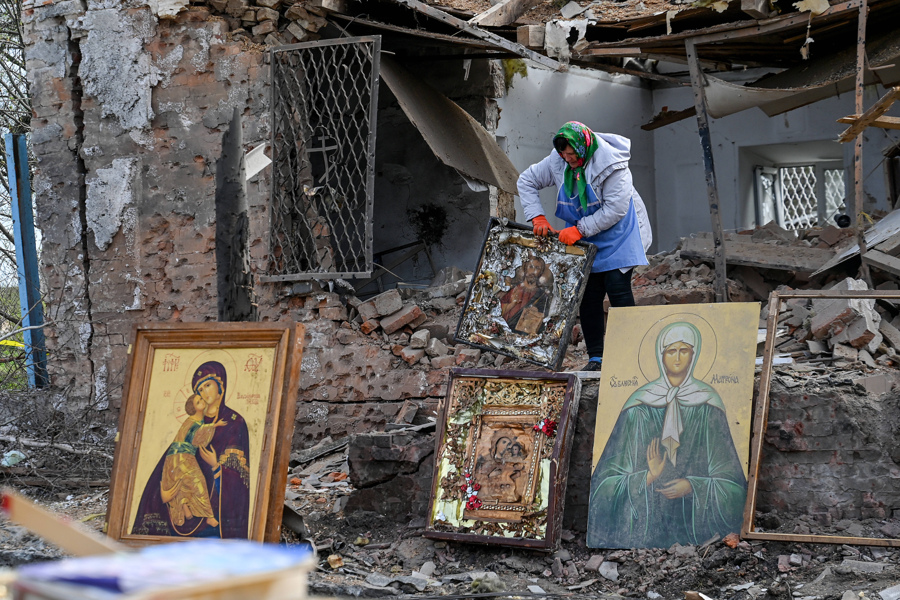
A woman salvages icons from the ruins of the Church of Saint Michael the Archangel in Komyshuvakha, Zaporizhzhia Region, reduced to rubble on Easter Night 2023. (IMAGO/ Ukrinform)
The Emser Decree was an attempt to erase Ukrainian language and identity within the Russian Empire. Looking from today's perspective: what continuities do you see between historical forms of cultural suppression and current Russian policies in occupied Ukraine?
By the time Tsar Alexander II signed the Emser Decree, the Russian Empire had already implemented policies that prioritized the Russian language and cultural practices throughout the empire.
But this decree incorporated goals and tactics specific to Ukraine. One of Alexander’s advisors alleged that Ukrainians were striving for a free Ukraine in the form of a republic. The Tsar was persuaded that Ukrainians’ expressions of independence had to be eliminated, and that the way to do it was through culture and language. It was, in short, the beginning of a new chapter in relations between the Russian Empire and its Ukrainian subjects.
We see continuities today from the Emser Decree‘s strict limitations on literary production and the dissemination of Ukrainian thought and knowledge. From Empire to Soviet Union tot the Russian-occupied territories of Ukraine, there is a linguistic and cultural hierarchy in which the Ukrainian language is harshly managed because its speakers were, and are, regarded as political threats to Moscow.
You use the term ‚natiocide‘ to describe what is happening in Ukraine. How does this concept change how we think about cultural destruction as a political strategy?
Natiocide is a concept coined by legal theorist Volodymyr Pylypenko. He notes thatbuilds on the original understanding of genocide developed by jurist Raphael Lemkin’s in the late 1940s original formulation of genocide, which included crimes intended to destroy the national pattern of an oppressed nation and replace it with the national pattern of the aggressor the destruction of a nation’s cultural identity and its replacement with that of the agressor. This two-stage pattern, for Lemkin, was part of cultural genocide. The 1948 Genocide Convention compromised on cultural genocide elements in favor of biological destruction, including killings and the prevention of births. Today, Pylypenko seeks to change international law to criminalize specifically the destruction of a nation.
My focus is different. I’m a sociologist, not a legal scholar, and I use natiocide as an analytical category of social and cultural domination. One thing that’s important to emphasize is that Russia’s goal is the cultural destruction of Ukraine – and there are political, military, economic, and legal strategies to reach that goal. We see this in the legal system that operates in the occupied oblasts. Language, religion, education, household formation, art and literature are all controlled and monitored for potential expressions of Ukrainian identity. So, I would look at your question from an alternative perspective. Cultural destruction is not a tool employed in the service of a political goal. Moscow deploys political tools to achieve cultural destruction.
Your research documents cultural violence well beyond language: destroyed archaeological sites, looted museums, and cultural objects reassigned to Russian cultural heritage. Which forms of erasure or appropriation concern you most?
Language and literature comprise the central cases of my forthcoming book, in part because Russia used facetious language grievances as pretext for its 2014 annexation and military interventionsoperations in Ukraine. It repeated those grievances in the lead-up to the full-scale invasion in 2022. But yes, there are other forms of erasure and appropriation that we should be thinking about. Among these, I am especially concerned about the forced transfer of Ukrainian children. First and foremost, their welfare – emotional, physical, social. The impacts on them as individuals and on their loved ones and caregivers. Rebuilding their lives and families after reunification will require intensive and sustained support. Along with this, I see how the large numbers of transferred children is one way that Russian tries to erode a future generation of Ukrainians. What we know about the fate of transferred children in occupation or the Russian Federation is that they are exposed to education and propaganda designed to turn them away from Ukrainian culture, ideas, and identity.
Looking beyond destruction, your current work also examines collaborative efforts to document cultural violence and protect cultural heritage in Ukraine. What have these initiatives revealed about how culture is defended and sustained under wartime conditions?
Documentation of cultural violence against Ukrainian cultural heritage is a collaborative effort combining ideas and techniques from Ukrainian civil society organizations, government cultural institutions, and international partners. This network of indefatigable individuals and groups is defying Russia’s assault on Ukrainian culture. The documentation they generate will have uses in legal accountability measures, we hope, but will go well beyond that by establishing a record of what happened, what was protected, what was lost, and who was lost. Because it’s not just objects and artifacts at risk in wartime conditions, it’s also the many Ukrainian artists, authors, photographers, journalists, musicians, and other creatives whose lives were cut short by Russia’s war.
Fiona Rose Greenland is Associate Professor of Sociology at the University of Virginia and a KIU Fellow (April–July 2026). Trained in both Classical Archaeology (D.Phil., Oxford University) and Sociology (Ph.D., University of Michigan), she combines perspectives from both disciplines in her research. Her current work develops the concept of natiocide. Her forthcoming book is under contract with Princeton University Press.