


KIUrious
Still Not Past: Chornobyl's Long Shadow over Ukraine
The images of Chornobyl seem familiar: abandoned houses, overgrown streets. Yet they tell only part of the story. Darya Tsymbalyuk shows what these representations obscure and how experiences of destruction and existential threat continue from 1986 into the war of the present.
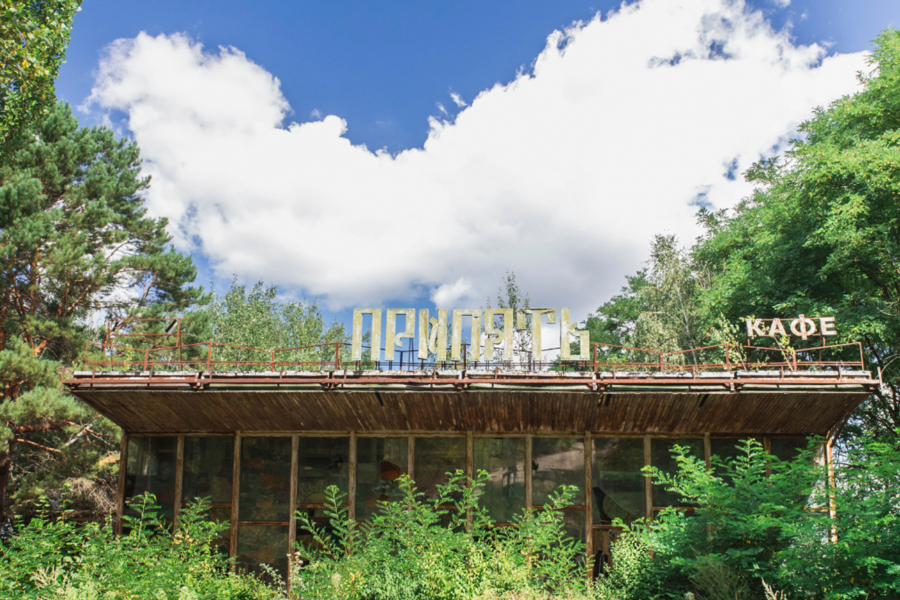
The overgrown ‘Prypjat’ restaurant in Chornobyl—named after the river that runs through the region. The image of ‘nature returning’ often shapes how people see Chornobyl, but it also obscures the full extent of the disaster’s consequences.
Chornobyl is often described as a technological and ecological disaster. But it also shook the Ukrainian society. What of this still resonates today?
Chornobyl profoundly shaped contemporary Ukraine. It is no surprise that one of Ukraine’s most prominent literary scholars, Tamara Hundorova called her seminal work on Ukraine’s literature post-1991 ‘Post-Chornobyl Library taking Chornobyl, rather than independence, as the key point of reference. The experience of witnessing and surviving Chornobyl deeply re-shaped our social and cultural understandings.
The legacies of the catastrophe are still visible today – in the materiality of nuclear contamination, in practices of soil remediation, and in the experience and memory of large-scale displacement. They persist in the memory of nuclear siren drills that children of my generation used to do in school, in the environmental movements and activism, and in the everyday knowledge of living on highly contaminated lands.
But the traces Chornobyl left are not only physical. Chornobyl also changed our relationship to time. Ukrainian society after Chornobyl is post-apocalyptic – and yet in today's war it is at once post-apocalyptic and living through an end of the world. In modern western epistemologies we think of time as linear, often as a progress line. Hence, the Anthropocene is imagined as a catastrophe to come. But for those living in the aftermath of one end of the world - such as the nuclear disaster - and inside another end, such as the war, as Ukrainians are today, here is a different kind of relationship to time and future, and a different sense of urgency and justice.
What connects 1986 to the full-scale invasion today?
I think we are still piecing the threads together, a task that is becoming both more difficult and more urgent, as people, places and the knowledge tied to them continue to be killed and destroyed.
Russia’s full-scale invasion follows and old imperial pattern of industrial violence: Ukraine has long been a site of large-scale resource extraction and landscape transformation through dams, monocultures, and coal mining. What was once built and exploited is now being violently destroyed.
The 2022 escalation began with the occupation of the Chornobyl Zone of Exclusion. The 2023 destruction of the Kakhovka dam brought back suppressed memories of the dam’s construction and the flooding and displacement that it caused in the 1950s. And there are many other examples that do not make international headlines, such as the pollution caused by an alumina plant in my hometown of Mykolaiv in southern Ukraine, which was built as a large-scale project during the Sovied period and until 2022 was de-facto owned by a Russian oligarch.
The literary and cultural scholar Rob Nixon famously articulates environmental displacement in his concept of slow violence - damage that develops gradually and often remains invisible: radiation seeping into soil, cancers that appear decades later, environments that quietly become uninhabitable, species extinction.What we see with Chornobyl and in the current war is a combination of slow and fast violence: The immediate destruction that makes headlines, and the invisible harm that unfolds across generations. Both result in many different forms of displacement: people are forced from their homes, but also displaced in place, without moving, as their environments become contaminated and unsafe.
When we ultimately think of the death toll both in Chornobyl and now in the war, this toll is significantly lower than the truth, as many deaths are not immediately visible, including those that emerge years through illness or shorten life expectancy.
At the same time, Chornobyl is an end of the world, it is a loss of an entire world, which was and is inhabited by all kinds of species. Russia’s war against Ukraine is equally a loss of many worlds, from sandy spits to forests and seas. No number will ever do justice to that.
Abroad, Chornobyl has become a stage set for tourists, video games, and visions of nature reclaiming itself. What remains hidden in this way of looking?
For years I felt rather annoyed that all that people knew about Ukraine and especially Ukraine and the environment was Chornobyl. As I have written with my colleague Tanya Richardson, Chornobyl often came to stand in for Ukraine itself, a space of the Other, an exotic space of destruction. And this narrative plays on two opposing images: nuclear wasteland and nature reclaiming itself after the catastrophe. This narrative of a miraculous return of nature is also now present at the former Kakhovka reservoir whose exposed bed, laid bare after the destruction of the dam in 2023 , is now being reclaimed by new vegetation.
People often ask me both about Chornobyl and Kakhovka. Questions are reflections of ourselves, and to me such questions and narratives speak about our desire to believe that no matter how much damage we cause, it will be fine, nature will return – and I think that is a rather dangerous path, one that risks enabling more reckless destruction in the future and absolves us of responsibility.
World-ending experiences like Chornobyl or the ongoing war exceed what language and images can capture. That is something I struggle with every day, and precisely because I feel out of words, I keep searching for them. In my current work, I’ve been thinking a lot about the Ukrainian word perebuty, which I speculatively translate as to over-be, to over-exist. It is my attempt to articulate something that has no equivalent in English and German, it is a complex and ambiguous word, that both faces the destruction and attempts to stay attuned to forms of life on the ground. It is impossible to explain it in a sentence, and that is why I keep writing about it.
Darya Tsymbalyuk is Assistant Professor at the Department of Slavic Languages and Literatures and the Committee on Environment, Geography and Urbanization at the University of Chicago. Her book Ecocide in Ukraine: The Environmental Cost of Russia's War (Polity, 2025) was awarded the 2025 Kovaliv Prize and 2026 ASU Humanities Institute Prize.