


KIUrious
Chornobyl as an infrastructure of power
Chornobyl was a major technological project that was part of Soviet power politics - and ultimately paved the way for Ukraine's independence by triggering protests. Forty years after the reactor accident, the fear of a nuclear catastrophe due to the Russian full-scale invasion has taken on a new meaning. An interview with historian Klaus Gestwa.
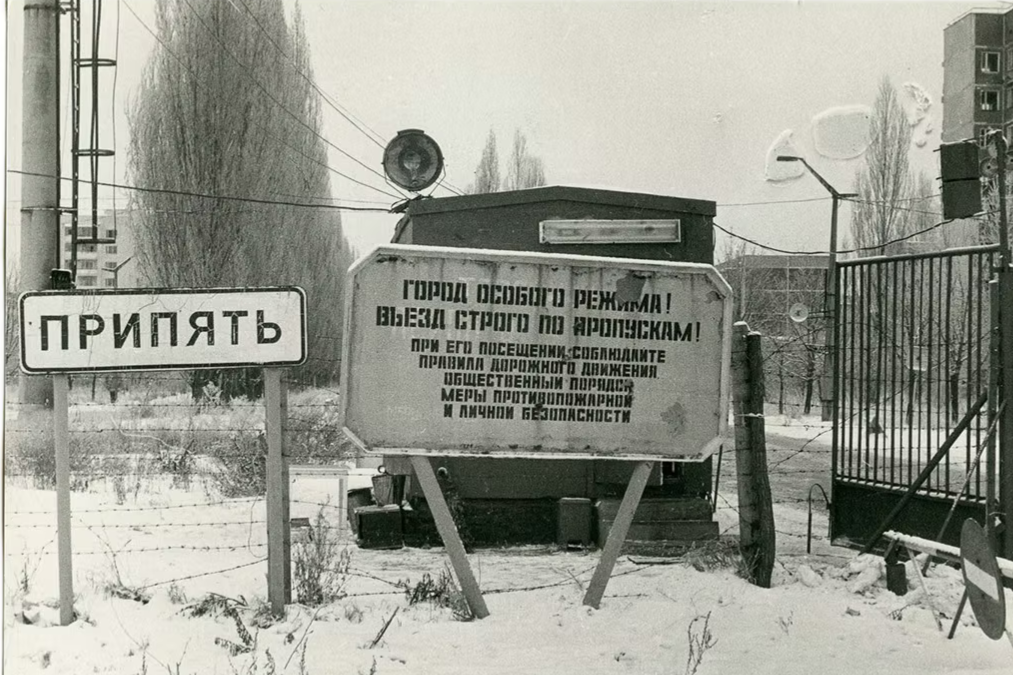
The photo shows the town sign of Prypyat, labelled as a restricted area. Photographer Viktor Marushchenko documented the events immediately after the disaster in 1986. More than three decades later, in 2022, Russian troops entered the exclusion zone © Untitled/ Viktor Marushchenko.
In the shadow of the Russian full-scale invasion of Ukraine, this year marks the 40th anniversary of the Chornobyl reactor disaster. What did such major projects mean for the Soviet leadership?
Political power and large-scale technological projects went hand in hand in the Soviet Union from the very beginning. After 1917, the new rulers in the Kremlin wanted to transform the backward empire into a modern industrial power in the shortest possible time. Lenin's formula from 1920 ‘Communism - that is Soviet power plus electrification of the entire country’ sums it up: power and rapid modernisation went hand in hand.
The major energy and infrastructure projects from the late 1920s onwards, often built with mass forced labour, attracted enthusiasts as well as the disenfranchised and persecuted: Those who sacrificed themselves for the five-year plans could become part of the new ‘Soviet people’. This brutal industrialisation destroyed social environments and ecosystems, but at the same time laid the foundations for the Soviet Union's rise to superpower status.
Even after Stalin's death in 1953, nuclear power continued to gain importance in the Cold War and, alongside space travel, became the new surrogate battlefield - here the Soviet Union was to prove its superiority with pioneering achievements. The Soviet leadership was convinced that with the dawn of the nuclear age, the victory of communism was imminent.
In 1954, the world's first nuclear power plant went into operation in Obninsk, south-west of Moscow. Large reactor plants were also built on the banks of the Dnipro in Soviet Ukraine, the course of which had already been ‘conquered’ by six dams: first in Chornobyl in the north of Ukraine from 1970, later in Zaporizhzhya in the south-east from 1980.
However, the belief in nuclear progress soon suffered a brutal break: celebrated as the ‘Titan of the Soviet energy industry’, Chornobyl turned out to be the Titanic of the nuclear industry after the explosion of the fourth reactor block on 26 April 1986. The illusion that Soviet technology was the best in the world was shattered.
Ukrainian civil society is often regarded today as active and resilient. But what role did Chornobyl play in its development and Ukraine's independence?
Ukrainian civil society politicised quite late - but then with a vengeance. In addition to the call for democratic participation, cultural independence and an honest reappraisal of history, it was above all the massive environmental pollution that drove people onto the streets. Ecological concerns developed into questions of democratic co-determination and national independence.
It was no coincidence that the Ukrainian national movement Ruch was founded in the summer of 1989: six months earlier, all news blackouts about Chornobyl had been lifted. Suddenly, the media ruthlessly revealed how catastrophically the state crisis management had failed. Trust in the Soviet party state was shattered.
In August 1989, people marched through Kyiv with blue and yellow flags and demanded ‘a Nuremberg trial for Chernobyl’. In October 1990 - on the square that is now called Maidan - the ‘revolution on granite’ set the course for a democratic, independent Ukraine. The outrageous accusation of a ‘nuclear genocide’ made the rounds. Chornobyl was therefore not just an environmental disaster. The explosion of the fourth reactor block acted as a crisis accelerator - and shortened the political half-life of the Soviet empire.
A good four decades after Chornobyl, the nuclear risks posed by the Russian full-scale invasion have become a new hot topic. What role does nuclear energy play in Russia's power politics today?
In the Russian Federation, the Soviet nuclear archipelago was reorganised in the new state holding company Rosatom, which gained influence during Putin's term of office. Rosatom is now not only involved in the development of modern weapons systems, but also serves the Kremlin to create new energy dependencies through the export of reactors, fuel rods and enriched uranium, thereby consolidating Russia's position on the world market and in global politics.
Belarus, one fifth of whose territory is contaminated with radiation from the radioactive fallout of 1986, will soon generate a large proportion of its electricity from two nuclear reactors supplied and financed by Russia. Kazakhstan, which suffers from a dark nuclear past with the Semipalatinsk nuclear weapons test site, has now also decided in favour of building a new nuclear power plant under the leadership of Rosatom following a referendum. Ukraine also continued its cooperation with Russia after 1991. After 2014, it cut its dependence on Rosatom, producing more than half of its electricity in 2021 with four nuclear power plants.
The current war reminds us that nuclear power plants are not only efficient suppliers of electricity, but also potential weapons of mass destruction if they get out of control or are deliberately destroyed: In February 2025, a Russian drone penetrated the protective cover over the reactor block that was damaged in 1986. Russian units had already advanced into the exclusion zone in 2022, stirring up radioactive dust and digging trenches in highly contaminated areas. And power and water supplies to the Ukrainian nuclear power plants are repeatedly interrupted by attacks. As a result, the nuclear fears handed down from the 1980s are being given an eerie update with the current war. This makes the 40th anniversary of the Chornobyl meltdown particularly poignant.
Klaus Gestwa is Professor of Eastern European History and Director of the Institute for Eastern European History and Regional Studies at the University of Tübingen and researches the technological and environmental history of the Soviet Union.
Editor's note: This is a machine translation generated by Deepl.