
Hungary – Parliamentary Election 2026
Hungary after the elections – what does Magyar’s victory mean for relations with Ukraine?
In the Hungarian parliamentary election Péter Magyar and his TISZA party defeated the incumbent Viktor Orbán. Political scientist Dr. Sonja Priebus of the European University Viadrina says that whilst the election results will usher in closer EU- Ukraine relations, the national-conservative positions heavily associated with Orbán will remain under the new government, and bilateral conflicts with Kyiv are likely to persist for the time being.
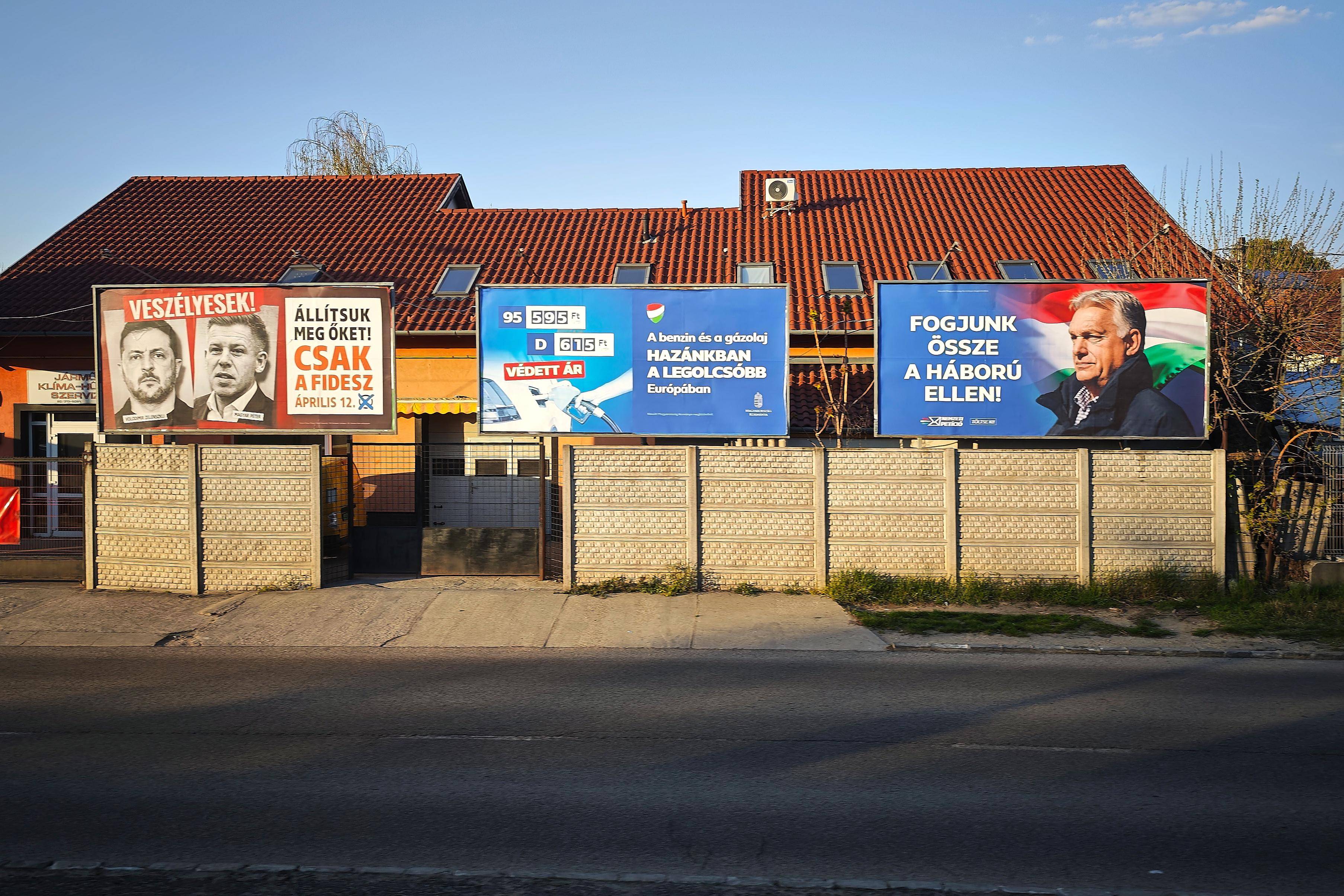 Budapest, Hungary, 11 April 2026: Campaign posters on the eve of the parliamentary election. On the left, a poster by the ruling party Fidesz shows Ukrainian President Volodymyr Zelenskyy alongside opposition frontrunner Péter Magyar, accompanied by a warning message and a call to vote for Fidesz on 12 April. On the right, a poster featuring Prime Minister Viktor Orbán. (Imago/dts Nachrichtenagentur)
What role did support for Ukraine play in the Hungarian election campaign?
For years, the strategy of the Fidesz-KDNP government under Viktor Orbán was to stoke fear by invoking both internal and external enemies that threatened Hungary. Following Russia’s full-scale invasion of Ukraine in 2022, Ukraine and the European Union were derided as these enemies.
During the election campaign, the KDNP-led government sought to exploit this fear, making support for Ukraine a central campaign issue. Orbán’s campaign repeatedly claimed that opposition candidate Péter Magyar was a puppet of Brussels and Ukraine, who wanted to install a subservient Ukraine-friendly government willing to divert Hungarian taxpayers’ money to Ukraine.
In the weeks leading up to the election, this narrative was constantly pushed by Orbán, who claimed that the choice on 12th April was an easy one: a choice between a pro-Ukrainian government, dictated to by Ukrainian President Volodymyr Zelenskyi, or a pro-Hungarian government.
Among opposition parties, by contrast, Ukraine played little role. Newcomer Péter Magyar and his TISZA party focused on bread-and-butter issues such as the deteriorating healthcare system, social services, education, systemic corruption, and poor economic performance. They deliberately avoided ideologically charged topics such as migration, democracy, or the war in Ukraine, and did not engage with what they saw as conspiracy theories promoted by Orbán’s government.
During Viktor Orbán’s time in office relations between Hungary and Ukraine deteriorated, with public disputes erupting over the Hungarian minority in western Ukraine as well as over energy policy. Does the election result signal a shift in Hungarian- Ukrainian bilateral relations?
Bilateral relations have been strained in recent years, culminating in numerous provocations by the Hungarian government ahead of the elections. One example is the unlawful confiscation of gold and cash belonging to Ukraine’s Oschadbank by Hungarian authorities in early March 2026. The Ukrainian government’s suspension of oil deliveries via the damaged Druzhba pipeline was also exploited for political gain by the Hungarian government.
Against this backdrop, Ukraine’s foreign minister Andrii Sybiha welcomed the change in government, whilst cautioning against overly high expectations. The Orbán government caused considerable damage to bilateral relations, and rebuilding trust will take time. However, a thaw in relations is still expected: the tone will likely become less confrontational, and relations more cooperative.
Magyar and his party have consistently supported Ukraine since February 2022 and have been clear in naming Russia as the aggressor. Magyar does, however, oppose fast-tracking Ukraine’s EU membership. It should also be noted that Magyar holds national-conservative views and consistently emphasises that his priority is Hungary’s national interests. Controversial issues, such as the political and legal issue of the Hungarian minority in Ukraine, will likely remain high on his agenda and will need to be resolved through bilateral negotiations.
Budapest has recently blocked key EU decisions regarding Ukraine, including sanctions and the prospect of accession. What does the change in power in Hungary mean for the EU’s policy toward Ukraine?
For years, the Hungarian government acted as a Trojan horse within the EU, representing Russian interests at the negotiating table, blocking key decisions, and preventing the EU from presenting a united front.
The day after the election, Magyar publicly addressed the EU’s €90-billion-euro aid package for Ukraine and stated that since the decision had already been made in December 2025, Hungary’s retroactive approval was unnecessary. Magyar also announced, however, that due to the country’s strained budgetary situation it would not financially contribute to the aid package.
This gesture alone indicates that we can expect tensions to ease at the EU level, but despite this general thawing in relations, disagreements and difficult negotiations regarding the EU’s policy towards Ukraine will likely continue, despite the change in government. This will not though be comparable to the total paralysis of European decision-making like during Orbán’s time as prime minister, with Magyar speaking openly about wanting to repair Hungary’s relations with Brussels.
This also does not mean that there will be a total break with Orbán’s foreign policy, with newly elected Prime Minister Magyar expected to pursue a pragmatic relationship with Russia, especially since the country is still heavily dependent on Russia oil and gas. This was immediately evidenced after the election when Magyar emphasised his willingness to continue dialogue and to speak with President Putin.
One positive consequence of Magyar’s election victory could be that it becomes easier for the EU to speak with one voice and act more cohesively. The change in government in Hungary offers an opportunity for a more effective common EU policy and greater global relevance.
Whether other European leaders, such as Slovak Prime Minister Robert Fico take over the role of EU disruptor, as recently speculated by Politico, remains an open question.
 Expert: Dr Sonja Priebus is currently acting professor of Comparative Politics at the European University Viadrina in Frankfurt (Oder), where she researches democratic backsliding and the erosion of the rule of law in EU member states, as well as the political systems of Central and Eastern European countries. In 2025, she co-edited with Timm Beichelt the volume Political Systems in Eastern Europe: Institutions, Actors and Processes, published by Springer.
Editor's note: The interview was conducted on 21 April.