

KIUrious
Fedorov’s Dismissal: What the Protests Reveal About Ukrainian Civil Society
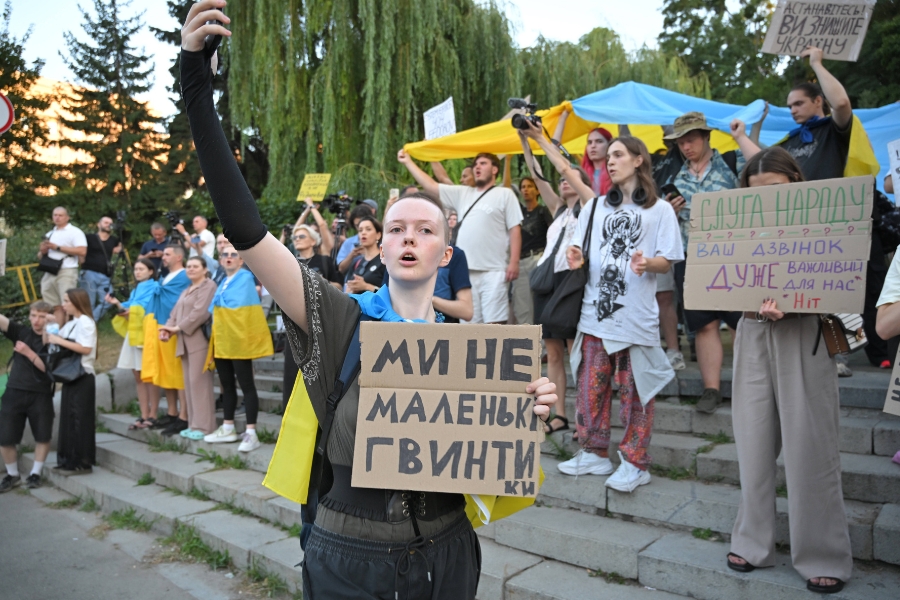
The dismissal of the Ukrainian Defence Minister Mykhailo Fedorov has sparked nationwide protests. What do these demonstrations tell us about the relationship between the political leadership and civil society in Ukraine? And what role do public protests play in democratic decision-making processes in the context of war? We discuss these issues with the social scientist and Ukraine expert Susann Worschech.
Mykhailo Fedorov’s dismissal came as a surprise to many Ukrainians and has sparked protests across the whole country. What makes him such an important figure in Ukrainian politics?
Fedorov belongs to a very young generation of politicians in Ukraine and is already, by his mid-30s, serving his second term as a minister. Since the election of President Zelenskyi in 2019, Fedorov has become a leading in the president's top team, with a number of successes credited to him. The high level of digitalisation and the significant expansion of drone operations – as well as the strategy of consistently integrating drones into the defence strategy and using them as an offensive tool – have earned him recognition, as this cleverly combines new technologies, modern strategies and, ultimately helps protect those risking their lives on the front line. Fedorov also belongs to the Maidan generation – those shaped by the pro-democracy protests, who were there themselves and who demand that the values associated with the Maidan, such as democracy, transparency and accountability be firmly embedded in the political system. Fedorov also enjoys the trust of the younger generation to ensure that Ukrainian politics undergoes a lasting ‘de-Sovietisation’.
The protests were not directed against President Zelenskyi in general, but primarily against the decision to dismiss Fedorov. What does this tell us about the relationship between the political leadership and wider society in Ukraine?
Although the protests were sparked by Fedorov’s dismissal, they actually went far beyond that. People were demonstrating less for (or against) a specific individual and more for the right to have a say in who their political representatives are. These protests highlight that democracy in Ukraine is very much alive, but also that it stems primarily from society itself, which is miles ahead of institutions when it comes to participation and transparency.
The political leadership in Ukraine, and President Zelenskyi in particular, has repeatedly displayed authoritarian tendencies in making decisions that intentionally bypass Ukrainian society. Ukrainian society is highly attuned to this and organises protests to act as a corrective. This is both a strength and a weakness: civil society reliably provides the checks and balances necessary in any democracy and forces the government to change course from time to time – not least because these checks and balances within the political institutions themselves are still too weak. The low level of trust in ‘politics’ amongst Ukrainians also helps create a strong civil society, but this carries its own problems. Political trust and democratic oversight processes need to become first established in any democracy; in this respect, Ukraine is well on the way, and a vigilant civil society is extremely valuable – particularly during periods of transition, and all the more so during such a destructive war. Nevertheless, it is essential to strengthen institutionalised oversight processes and the trust between society and political actors.
Last year, many Ukrainians took to the streets to protest against the curtailment of the powers of Ukraine's anti-corruption bodies. Protests are once again taking place against a political decision. What role do such protests play in democratic decision-making processes in the context of war?
No one outside Ukraine can really imagine how exhausting and demanding it must be to keep a society – one that is not only undergoing transformation but also at war – democratically vibrant, and to continually hold the government to account for its democratic principles. The fact that the surge towards autocracy so typical during wars has not materialised and that, whilst Ukraine is experiencing a massive strengthening of the executive due to martial law, the government is nevertheless not being given a political free pass is a tremendous achievement for Ukraine.
At the same time, it is not good for any democratic society to be unable to hold elections for such a long time. It is indisputable that elections in Ukraine are currently impossible both legally and in practice, but this is, of course, a severe blow to Ukrainian society’s democratic self-image. I find it interesting how Ukrainian society is currently attempting, through enormous public attention and a very lively discourse, to exert influence on political decisions and processes. In the process, new forms of participation are emerging, along with a sort of ‘trial-and-error politics’, in which decisions are made gradually and under the influence of public debate. The fact that the personnel reshuffle did not take place all at once, but was staggered over several days, shows that there is certainly a kind of dialogue when major decisions are on the agenda – a sort of step-by-step decision-making process following an initial major upheaval, in which public opinion plays a role. This kind of informal negotiation between those in power and the governed is an intriguing model of democracy under wartime conditions. Here, too, Ukraine is proving to be innovative.
Expert:

Dr. Susann Worschech, KIU Academic coordinator
European University Viadrina