

Sur-Place Fellows Summer Term 2026
Lesia Bidochko

Lesia Bidochko
Lesia Bidochko is a two-time KIU Research Fellow and currently serves as a Policy Fellow at the European Policy Institute Kyiv (EPIK) and Assistant Professor of Political Science at the Kyiv-Mohyla Academy. Her work bridges academia and policy analysis. Previously, she was Deputy Head of the Detector Media Research Center, focusing on Russian FIMI, disinformation campaigns, and strategic communications. As a country expert for the Counter Extremism Project, she analyzed Russian propaganda in Germany and its links to foreign fighter recruitment. Her research examines Ukrainian far-right movements and other sensitive issues often instrumentalized by Russian propaganda.
KIU-Research project ‘The Ukrainian far-right’s attitudes toward ethnic minorities: Between ideological prejudice and wartime pragmatism’
This research project examines the attitudes of Ukrainian far-right groups toward ethnic minorities amid Russia’s war against Ukraine. It explores the tension between deep-rooted ideological prejudices (e.g., antisemitism, anti-Romani bias, Hungarophobia, xenophobia toward recent migrants from Africa, Asia, and the Middle East) and wartime pragmatism, evident in strategic alliances against Russian aggression. This contradiction raises important questions about how war changes far-right beliefs. It may soften outward biases or worsen them through militarized nationalism. The project intentionally leaves out the examination of far-right views on the Russian ethnic minority since these attitudes are mainly influenced by political opposition to Russia rather than ethnic prejudice itself.
Research interests:
- Ukraine’s Euro-Atlantic integration
- Russian FIMI campaigns and informational influences
- REMVE groups
Nadiia Bureiko
Olga Chyzhova
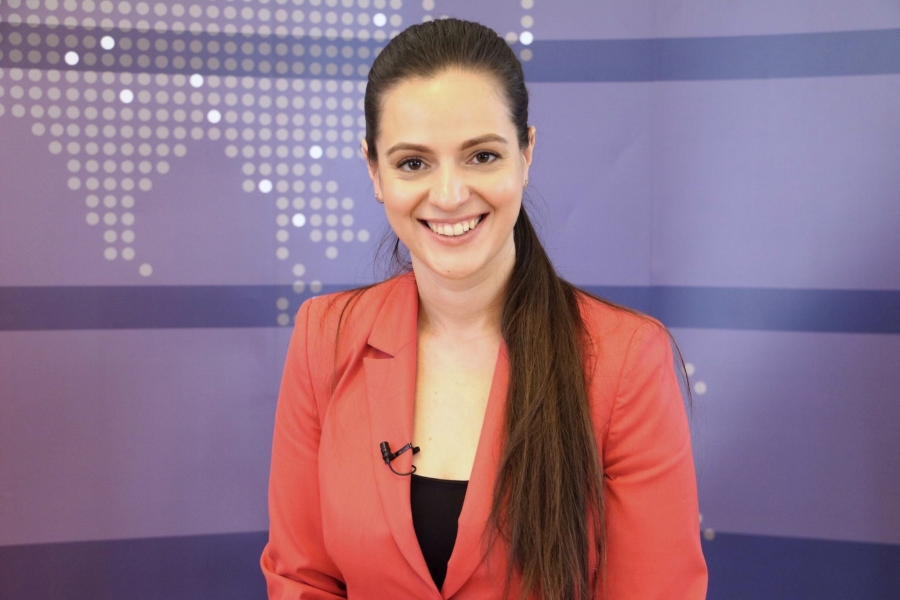
Nadiia Bureiko is ‘Ukraine Abroad’ Program Director at the Foreign Policy Council ‘Ukrainian Prism’ (Kyiv). Most recently, she has been a research fellow at the IERES at George Washington University and the Institute for Advanced Study at the Central European University. She previously conducted postdoctoral research at the University of St. Gallen and at the New Europe College. Nadiia holds a PhD in Political Science and an MA in International Relations from Chernivtsi National University. She has published in academic journals including Europe-Asia Studies, Problems of Post-Communism, and Southeast European and Black Sea Studies, as well as in volumes published by Routledge and Manchester University Press.
KIU research project: ‘Whither (in)difference? Sense of belonging, attachments and loyalties among the Romanian minority in wartime Ukraine’
This project seeks to better understand attachments, loyalties and sense of belonging among the Romanian minority in Ukraine and to identify the factors that shape and influence them under wartime conditions. Building on prior research, the project argues that despite cultural differences and wartime disruptions, members of the Romanian minority maintain strong attachment and loyalty to the Ukrainian state. Theoretically, the study challenges the concept of ’national indifference’ by applying it to the case of Romanians residing in the Bukovyna borderland. Methodologically, the project employs a mixed-method research design and generates new empirical evidence with important implications for minority policy in Ukraine.
Research interests:
- national identity and minorities in Ukraine
- Ukraine’s public diplomacy and image formation
- European integration and EU’s neighbourhood policy
Yuliia Fetko

Yuliia Fetko
Yuliia Fetko, Director of the Research Institute of Fundamental and Applied Studies of European Territorial Cooperation of the Uzhhorod National University, Associate Professor of the Department of International Law, Doctor of Philosophy in Law, Associate Profess.
Research interests focus on European Union law, the legal regulation of European integration processes, the study of legal mechanisms of EU territorial cooperation, as well as the legal aspects of interaction between the national legal system of Ukraine and European Union law, including the processes of legislative approximation to the EU acquis.
KIU research project: ‘Adaptation of the EU Cohesion Policy Acquis in Ukraine: Legal and Institutional Mechanisms’
The project examines how legal and institutional approximation to the EU cohesion policy acquis in Ukraine affects the protection of minority rights, the formation of regional identities, and the development of inclusive multi-level governance, with particular attention to border and multiethnic regions neighbouring EU Member States. Special emphasis is placed on the role of the principles of partnership, subsidiarity, and territorial cooperation in transforming interactions between the state, local communities, and minorities in the context of accession negotiations, war, and post-war recovery.
Research interests:
- EU cohesion policy acquis and legal and institutional approximation in Ukraine’s accession process
- minority rights protection and inclusive governance in border and multiethnic regions
- territorial cooperation, regional identities, and Europeanisation in the context of war and post-war recovery
Mykola Homanyuk
Kostiantyn Kruhlikov
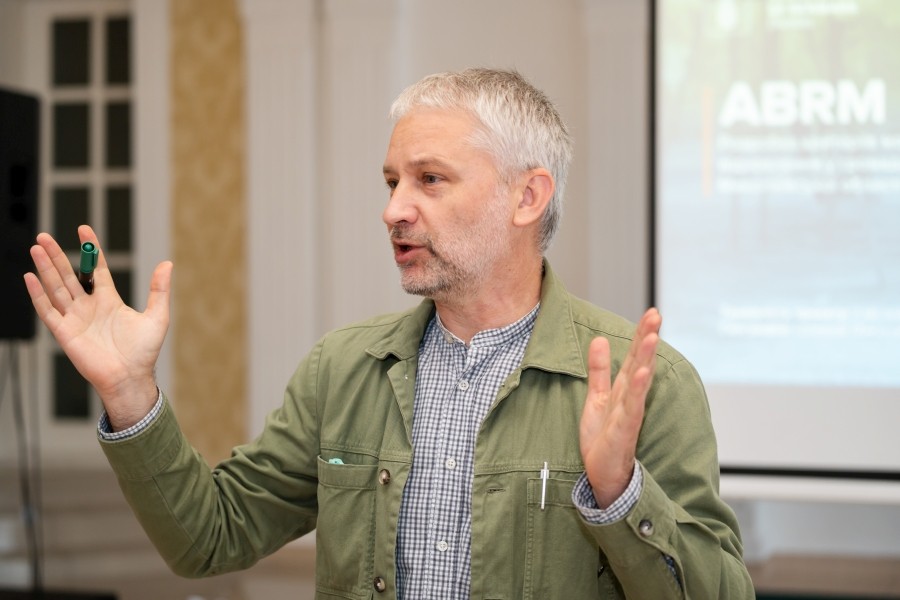
Mykola Homanyuk, sociologist and geographer, is an associate professor at Kherson State University. He defended his PhD thesis in sociology at V.N. Karazin Kharkiv National University. Mykola is the author of numerous articles on mental mapping and toponomy in Ukraine, ethnic studies, as well as memory and commemoration. Since 2022 he has done several studies about the consequences of Russia’s war in Ukraine. He recently finished his book Monuments and Territory: War Memorials in Russian-Occupied Ukraine (with Mischa Gabowitsch) published in CEU Press. In 2025 Homanyuk was awarded the Journalism Excellence Award by the Council of Europe.
KIU research project: ‘Disappearing minority: Russians in Ukraine after 2022’
Until recently, Russians were the largest national minority in Ukraine. Sociological survays conducted after 2022 show that the number of Ukrainian citizens who identify themselves as Russians has decreased several times over. The aim of Mykola Homanyuk's research is to provide a comprehensive description of Russians in Ukraine as a national minority. The main research question is: what are the sources of identity (belonging) of present-day Russians in Ukraine, and how does the Russian-Ukrainian war affect the feeling of (non) belonging to this minority?
Research interests:
- memory studies
- Roma in Ukraine
- mental mapping
Martin-Oleksandr Kisly
Martin-Oleksandr Kisly
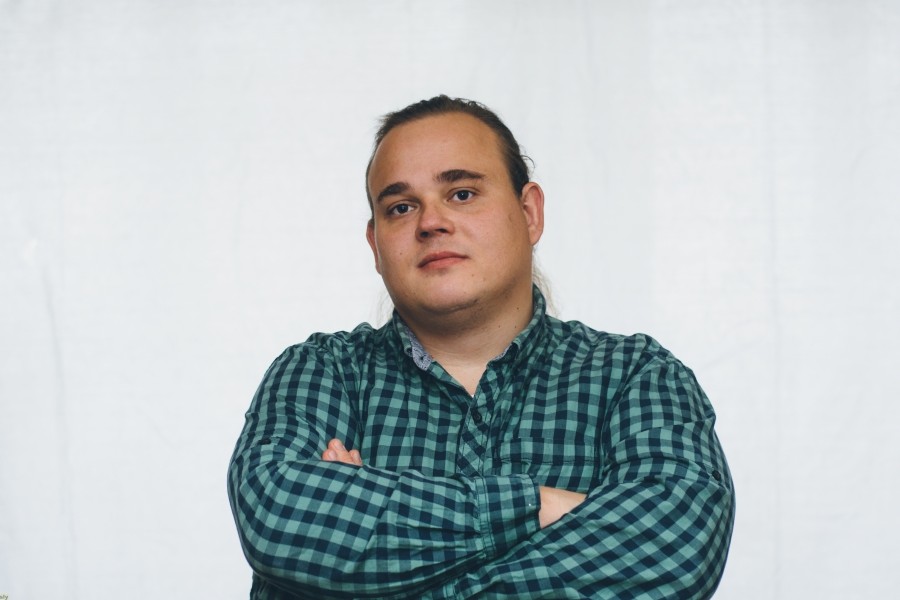
Martin-Oleksandr Kisly, Crimean Studies Center at National university of Kyiv-Mohyla academy.
Was born in Simferopol, Crimea. A historian of Crimea and Crimean Tatars with a focus on Soviet and post-Soviet periods. In 2021 he defended a PhD dissertation entitled ‘Crimean Tatars’ Return to the Homeland in 1956–1989’. His research interests include (but not limited to): oral history, memory, trauma, identity, migration and colonialism. Expert of a Council on cognitive de-occupation (Mission of the President of Ukraine in the Autonomous Republic of Crimea), Executive director of RUTA Association for Central, South-Eastern, and Eastern European, Baltic, Caucasus, Central and Northern Asian Studies in Global Conversation.
KIU research project: ‘Homeland or Death: The Evolution of Sacrificial Narratives in Crimean Tatar Identity and Resistance (1960s–Present)’
This project traces the genealogy of the Crimean Tatar slogan ‘Homeland or Death’ (Vatan yahud Ölüm), from its 1960s origins to its role under current Russian occupation. It analyzes how the slogan evolved from a mobilization metaphor into a lived reality of sacrifice, exemplified by Musa Mamut’s 1978 self-immolation and Reshat Ametov’s 2014 martyrdom. By examining the shift from the struggle for return to the defense of national dignity, the research asks: does this paradigm remain a functional mobilizer in contemporary discourse, or has it become an archaic relic of a past struggle.
Research interests:
-
oral history
-
memory studies
-
migration studies
-
colonialism
Vladyslava Moskalets
Olha Klymuk
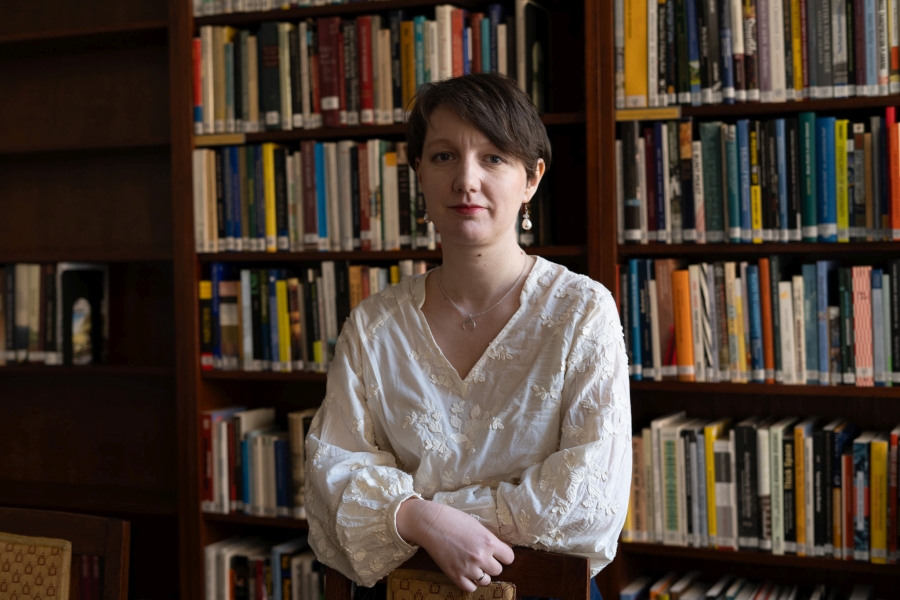
Vladyslava Moskalets is a historian who specialises in the social history of the Jews of Habsburg Galicia. She received her PhD in History from Jagiellonian University in 2017. She is a researcher at the Center for Urban History of East-Central Europe and an associate professor in the History Department at the Ukrainian Catholic University in Lviv, Ukraine. Since 2016, she has taught courses on Ukrainian and Jewish history in the 19th century, the history of consumption, and Hebrew. She was an external fellow at the Doktoratskolleg Galizien programme (University of Vienna) from 2013 to 2016, and a Fulbright Scholar Fellow at Northwestern University in Chicago from 2018 to 2019.
KIU research project: ‘Liminal Landscapes: Rethinking Cultural Hybridity Through Carpathian Jewish Life’
This project examines Jewish cultural life in the eastern Carpathians during the nineteenth and twentieth centuries, focusing on everyday relations between Jews and non-Jews in rural mountain communities. The liminal space of the Carpathians fostered distinctive forms of coexistence, offering challenge to the previous models, based on urban communities. Drawing on literary sources in Ukrainian, Polish, and Yiddish, and the material culture, the study demonstrates how Jews functioned as intermediaries between peasant communities and nearby towns. The project employs the concept of cultural hybridity to rethink Jewish–Gentile relations in a rural context, arguing that Carpathian villages fostered multiple hierarchies.
Research interests:
- social history of jews
- history of Habsburg Galicia
- studies of urban elites
Roman Samchuk
Roman Samchuk
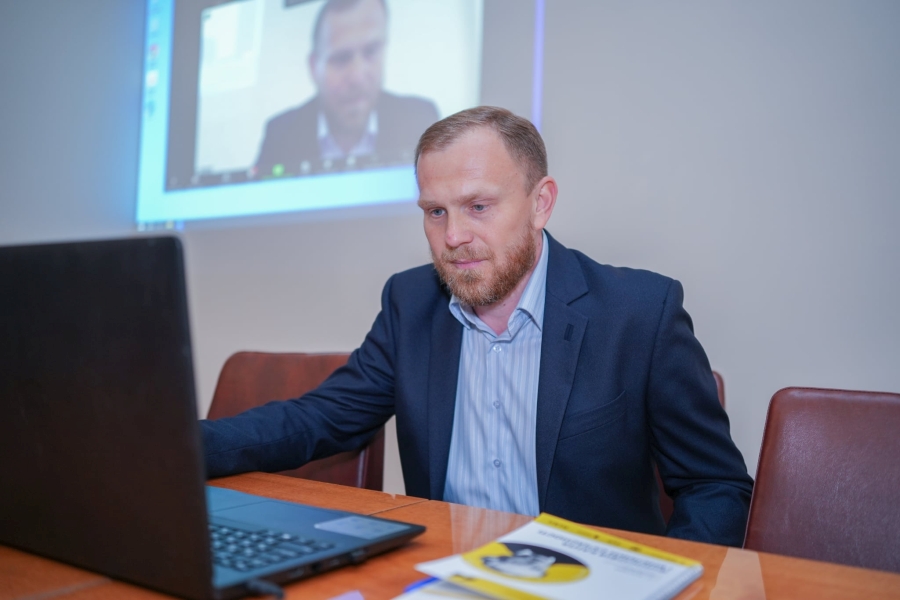
Roman Samchuk, is a historian of philosophy, currently working as a Scientific Secretary at H.S. Skovoroda Institute of Philosophy of the National Academy of Sciences of Ukraine. He has been working at the Institute during his entire career. His current research focuses on contemporary processes of transformations of Ukrainian identity. Beside this, his research field is the history of philosophy in the Soviet Ukraine, as he worked as a Researcher in the Department of Foreign Philosophy. Earlier, he studied humanistic psychology and human identity in the postmodern world.
KIU research project: ‘From Minorities to Solidarity: Reconceptualizing Identity within Ukrainian Academic Philosophy during the Full-Scale Invasion’
It focuses on the transformation within Ukraine’s intellectual and social landscape, which lies in the fundamental transition from the traditional framework of "minorities" to a new paradigm of "solidarity," as the full-scale war has reconfigured the role of ethnic communities. This shift is caused by a conscious existential choice and experience, shared agency and destiny. The project focuses on how philosophical discourse in Ukraine has documented, synthesized, and theorized this shift, attempting to identify the underlying conceptual structures of this new solidarity.
Research interests:
- identity in postmodern world
- intellectual history
- humanism
Oleksandr Zaitsev

Oleksandr Zaitsev
Oleksandr Zaitsev is a Ukrainian historian and Professor at the Ukrainian Catholic University (Lviv), specializing in the political history of interwar Western Ukraine and the intellectual history of Ukrainian integral nationalism. He is also a Senior Researcher at the Mykola Haievoi Center for Modern History. Zaitsev is the author of several monographs and numerous articles, and a recipient of prestigious fellowships (Fulbright, Harvard, CEU, Kennan Institute, etc.). His books includes Ukrainian Integral Nationalism of the 1920s and 1930s (2013) and Nationalist in the Fascist Epoch: Dmytro Dontsov's Lviv Period, 1922-1939 (2019), nominated for the Shevchenko National Prize in 2023.
KIU research project: ‘The Jewish Minority in Interwar Ukrainian Nationalist Discourse: From Conditional Inclusion to Radical Exclusion’
The project examines how Ukrainian nationalist thought in the 1920s–30s conceptualized Jews. Tracing a shift from conditional inclusion to increasingly radical forms of exclusion, the project analyses key thinkers, organisations, and texts, situating Jews alongside Russians and Poles as central to nationalist debates on loyalty, sovereignty, and social order. By exploring the “Jewish question,” it illuminates processes of boundary-making in a multiethnic space, offering insights into nationalism, minority politics, and the discursive construction of inclusion and exclusion in East-Central Europe.
Research interests:
- political history of Ukrainian community in interwar Poland
- Ukrainian integral nationalism
- Ukraine in the Kremlin’s politics of history
Oleksandr Zubariev
Stanislav Danilov
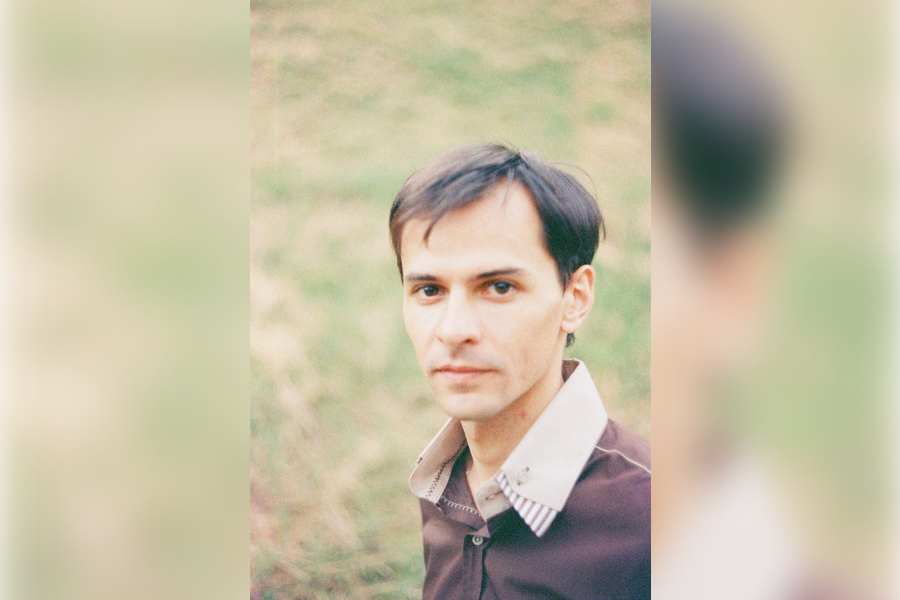
Oleksandr Zubariev is an Associate Professor at the Department of Sociology, Educational and Research Institute of Sociology and Media Communications at V. N. Karazin Kharkiv National University. He received his PhD in Sociology from the same university in 2016 with a dissertation on Eastern spiritual practices as a phenomenon of the lifeworld in a polycultural society. He has been working at V. N. Karazin Kharkiv National University since 2014, first as a Senior Lecturer and later as an Associate Professor at the Department of Sociology. His academic work focuses on sociological theory, religion, identity, and the sociology of the body. He is the author of a monograph, textbooks, and numerous articles in peer-reviewed journals.
KIU research project: ‘Eastern-Origin Religious Minorities in Ukraine: Identity Transformations and Resilience Strategies During the War’
The project examines how members of Buddhist, Hindu, and other Eastern-origin religious communities in Ukraine respond to the challenges of Russia’s full-scale invasion. The project focuses on identity transformations, resilience strategies, and experiences of displacement among religious minorities. It is based on qualitative research, including narrative and semi-structured interviews with members of Eastern-origin religious communities in Ukraine.
Research interests:
- sociology of religion
- sociology of the body
- qualitative sociological methods