


Elections in Ukraine? What the polls tell us (Inna Volosevych)
Elections in Ukraine? What the polls tell us
Inna Volosevych
President Zelenskyi is ready to hold elections as soon as the security situation allows, and for many Ukrainians this is no surprise. For the first time in three years polling companies are publishing data again. What do they tell us: a lot of possibilities, but no concrete predictions.
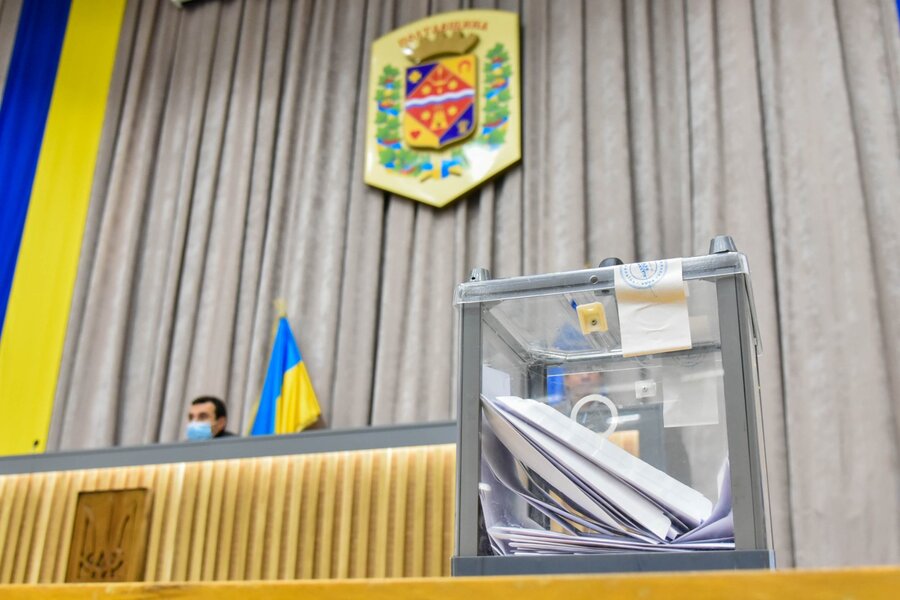
Ballot box with the Coat of Arms of Ukraine, 28 November 2020. (IMAGO/ Dreamstime)
President Zelenskyi’s regular five-year constitutional term formally ended in May 2024. Although no elections have been held since then due to the imposition of martial law, his legitimacy has not been questioned, even by his political opponents. Throughout this period, most Ukrainians have opposed to holding elections, whether presidential or parliamentary, whilst the war goes on.
Ukrainian Public Opinion on Wartime Elections
According to unpublished data from the Ukrainian polling agency Info Sapiens collected in March 2025, 76% of Ukrainians opposed wartime elections, with only 22% in favor - figures that have been corroborated by the Kyiv International Institute of Sociology (KIIS)¹. Over the course of 2025, KIIS, however, recorded a gradual shift in public attitudes: by December opposition to elections had fallen to 59%, while support had increased to more than one-third² . This shift coincided with a series of high-profile corruption scandals.
Wartime Legitimacy and Russian Interference
As of December 2025, more than half of surveyed Ukrainians continued to express trust in President Zelenskyi³. Beyond personal approval ratings, Ukraine’s political stability during wartime depends on institutional continuity. This emphasis reflects lessons from Ukraine’s past.
In February 2014, Viktor Yanukovych fled Ukraine in a Russian-backed escape, leaving a power vacuum in Ukraine. With the president serving as head of the armed forces, the consequences were severe - Russia seized the opportunity to capture Crimea largely without resistance.
Claims questioning President Zelenskyi’s legitimacy originate from outside from Ukraine.
It is Russia, despite its own record of electoral fraud and political repression, that is pushing the narrative of the current government's illegitimacy. This follows a pattern previously observed during Petro Poroshenko’s presidency after the events of 2014. Ironically, it is Russia’s full-scale invasion of Ukraine that has prevented elections from taking place.
Political Ratings Resurface in 2025
In 2022, polling companies in Ukraine unofficially agreed not to publish political ratings in wartime for three reasons: all efforts should focus on the war, free elections cannot take place under Russian occupation and thus elections are impossible without victory.
However, some companies started publishing ratings last year and many political statements appeared ‘on the basis of closed surveys’, which cannot be proved given the absence of open electoral data. In response to this situation, Info Sapiens and Public Policy Development Office (PPDO), launched the U Electoral Data Project.
The mission of the Project is to provide free access to reliable electoral data, independent of any political affiliations or interests.
According to these findings, the only possible competitor to President Zelenskyi is Valerii Zaluzhnyi⁴. Current polling data from December 2025 shows President Zelenskyi at 24% and Zaluzhnyi at 17%, with no other candidate exceeding 4%.
In parliamentary terms, only three parties - Sluha narodu (Servant of the People), Ievropeis'ka Solidarnist' (European Solidarity), Batkivshchyna (Fatherland) – will possibly remain in the Parliament, though they could be joined by many potential new parties made up of military veterans and volunteers, that may emerge in the run up to elections⁵. Whether those well-known figures will formally enter politics remains uncertain, but their wartime visibility positions them as potential challengers to the established parties.
Current Ratings Are Not Election Forecasts
It is important to emphasize that these surveys are carried out in wartime. Current ratings should, therefore, be regarded as the potential of individuals and their teams – not as predictions of actual election outcomes. Once hostilities cease and the security situation allows for elections three factors will determine the political landscape: first, the list of the candidates and parties can significantly differ from today. Second, the demographic situation will likely shift substantially, particularly due to the return of Ukrainians from abroad. Third, the ratings can significantly change once active campaigning starts, because no genuine electoral activities are currently taking place.
All in all, President Zelenskyi’s statement on openness to hold elections contains little that is new for a domestic audience. While Western media framed it as significant, it surprised few Ukrainians, who have long understood that security conditions are the decisive constraint. In practical terms little changes: elections can only be held one martial law is lifted, military operations have ceased, and there are credible guarantees that hostilities will not resume during the electoral process.
____________________________________________________________________________________
¹ – KIIS data from the same period show that 78% of Ukrainians opposed elections during wartime, while 19% supported them.
² Ibid.
³ According to unpublished Info Sapiens data from December 2025, 55% of Ukrainians expressed trust in President Zelenskyi, while 42% expressed distrust.
⁴ Valerij Zaluzhnyi is now the Ambassador in the UK, but he became a widely known figure as he was Commander of the Armed Forces in Ukraine in 2022. The trust to him is still higher than the trust to President Zelenskyi. According to unpublished Info Sapiens data from December 2025, 55% of Ukrainians expressed trust in President Zelenskyi, while 42% expressed distrust and Zaluzhnyi’s figures are 67% and 25%, respectively, presenting the highest level of trust among all Ukrainian politicians or public servants.
⁵ Possible new political actors alongside Zaluzhnyi include: Andrii Biletskyi (found of the Azov Regiment and former Member of Parliament), Kyrylo Budanov (Head of the President’s Office), Denys Prokopenko (Commander of the Azov Regiment during the defence of Mariupol), Serhiy Prytula (volunteer coordinator and public figure), Serhiy Zhadan (writer and cultural activist involved in humanitarian efforts).
____________________________________________________________________________________
Inna Volosevych is Deputy Director of Info Sapiens and co-founder of the U Electoral Data Project. In 2024, she was a fellow at the KIU Competence Network and in 2023-2024 – at the ZOiS Ukraine Research Network (UNET) at ZOiS, researching the impact of war on Ukrainian society. Inna has about 20 years of experience in conducting sociological surveys, specifically electoral polls in Ukraine and other European countries. She holds a Master degree in Sociology