


Elections under Martial Law – A Bad Idea Being Pushed Forward
Elections under Martial Law – A Bad Idea Being Pushed Forward
Prof. Dr. Oleksiy Haran
Under martial law, elections in Ukraine remain suspended. In recent months, however, the legitimacy of the Ukrainian government has been questioned by both the Kremlin and President Trump. Political renewal is needed, but elections can only take place once the war ends and security conditions allow. Still, electoral considerations are already beginning to shape political decision-making.
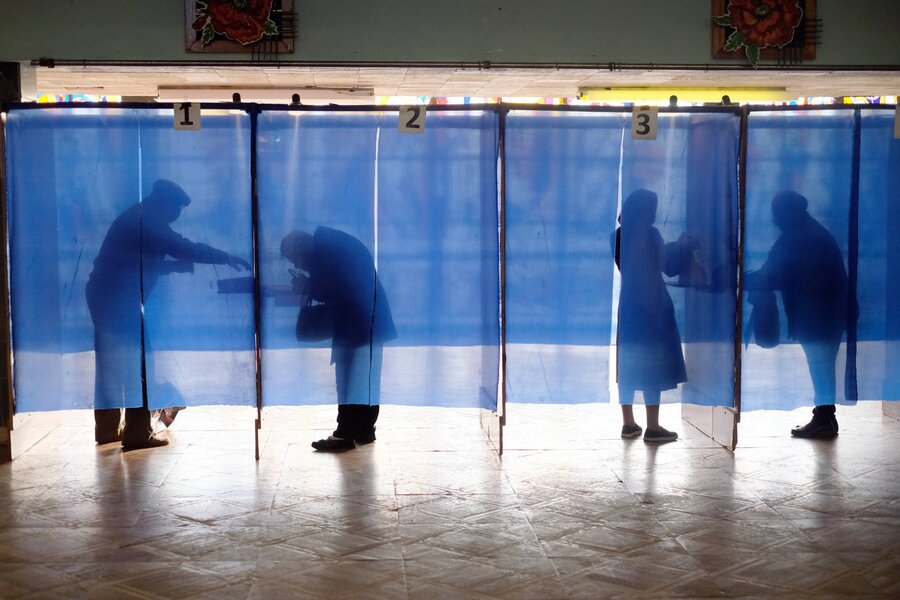
Voters make their choices inside the booths at a polling station as the 2020 Ukrainian local elections take place in Rubizhne (IMAGO / Ukrinform)
Legal Context
The Ukrainian Constitution explicitly prohibits both constitutional amendments and parliamentary elections during martial law. Presidential and local elections are not directly banned by the Constitution, but they have been suspended based on legislation on martial law and could, in principle, be changed by a simple parliamentary majority.
One of the important justifications for banning presidential, parliamentary and local elections is that free and competitive elections are impossible under the current conditions of war and martial law. However, the issue of presidential elections remains a potential question for Ukraine’s Constitutional Court, which has no interpretations on the issue so far.
Political Considerations
It is possible that the President’s Office at some point considered holding elections during the war, given that President Volodymyr Zelenskyi’s electoral rating skyrocketed after the start of the full-scale invasion. Nevertheless, at the end of 2023, parliamentary forces reached an agreement within the framework of the Jean Monnet Dialogue, a European Parliament-facilitated mediation format, that elections should only be held six months after martial law is lifted, and after the logistical challenges of ensuring Ukrainians residing abroad are able to vote have been resolved. Ukrainian public opinion is strongly against elections in time of war, even in case of ceasefire without security guarantees. They are afraid that Russia will use elections as a tool to destabilize the country.
Risks of Manipulation and Cyberattacks
Ukrainians have living experience of electoral interference and digital manipulation, which contributed to the 2004 Orange Revolution. The threat of Russian cyberattacks and attacks on critical infrastructure during elections could also disrupt voter turnout, the actual voting process itself and vote counting and, thus, undermine the legitimacy of the elections and results. Even during the Eurovision Song Contest, the high volume of calls from Ukrainians wanting to vote, temporarily disrupted the country’s voting process.
Further questions around how to ensure that international election observers can safely monitor and verify the election results would also need to be resolved. A lack of international verification would raise further questions about the legitimacy of the elections. Additionally, would international election observers be present on the ground in Ukraine if a ceasefire was not guaranteed?
Legitimacy and A Need for Renewal?
Under the Ukrainian Constitution, the incumbent government remains legitimate until a new one has been elected. The claims about the illegitimacy of the current Ukrainian government are a Kremlin talking point, which has, unfortunately, been echoed by President Trump. At present, without the participation of the very popular General Zaluzhnyi, President Zelenskyi remains the favourite. In a longer campaign, however, his chances of winning would likely diminish, and a single-party majority in the Ukrainian parliament would also be highly unlikely.
In 2022, Ukrainian sociologists informally agreed not to publish election pollings, though politicians continued to monitor them. However, since the end of 2024, some polling companies have begun releasing this public opinion data again, as the debate with President Trump over the need for elections in Ukraine, has intensified. Given the uncertainty over timing, conditions, and participants, publishing such data now risks fuelling societal tensions manipulated by Russia, ratherthan triggering informed political debate about the country’s future.The real problem is that a renewal of power after the 2019 elections is already necessary.
One alternative to holding national elections, would be to create a national unity government, bringing together major parliamentary forces and key political actors, something that President Zelenskyi has, however, continuously rejected.
According to experts, whilst active fighting continues, elections should first take place at the local level, followed by parliamentary elections, and with presidential elections only taking place after the complete end of the war. Nevertheless, the Kremlin, President Trump, and possibly even President Zelenskyi are all, for their own reasons, primarily focused on presidential elections
The Issue of a Simultaneous ‘Peace Plan’ Referendum
Proposals to hold presidential elections at the same time as a referendum on a so-called ‘peace plan’ are problematic and would favour President Zelenskyi. This could lead to the withdrawing of Ukrainian troops from the non-occupied part of Donbas region under huge pressure from President Trump and President Putin. It may also shift the responsibility away from President Zelenskyi to ordinary Ukrainians and, at the same time, present President Zelenskyi as a ‘saviour of the nation’ and a ‘peacemaker’.
Moreover, referendums are also prohibited during martial law. Even during peacetime, neither the Ukrainian president nor the Ukrainian parliament can convene a referendum at will, besides adopting some constitutional changes when referendum may be needed.
This leaves the ‘people’s initiative’, which requires the signatures of three million Ukrainians, as the only legal mechanism. Collecting signatures, usually done in public places, seems dubious during the war, however, technically, this might be feasible for the organisers of the referendum.
A January 2026 survey of the Kyiv International Institute of Sociology found that 55% of those polled support holding such a ‘peace plan’ referendum, while 32% oppose it and 14% remain uncertain. Nevertheless, even in peacetime, the legitimacy of such a referendum would be questionable. Would troop withdrawals constitute a violation of sovereignty and territorial integrity, which the Constitution explicitly prohibits? International law also considers agreements concluded ‘at gunpoint’ null and void, as exemplified by the notorious Munich Agreement, which only accelerated the outbreak of World War II.
Conclusion
It is in the interest of Ukrainians to hold fair and free elections when proper security conditions are in place, and after the war ends. However, under the dual pressures of President Trump and President Putin, it seems that elections are approaching, and, unfortunately, Ukrainian politicians are beginning to make decisions based on electoral considerations.
Prof. Dr. Oleksiy Haran is Professor of Comparative Politics at the National University of Kyiv-Mohyla Academy. He is also Research Advisor at the Ilko Kucheriv Democratic Initiatives Foundation which conducted the first exit poll in Ukraine, and its 2004 exit poll revealed falsifications and contributed to the Orange Revolution. His research focuses on Ukrainian politics, security issues, and public opinion.