

Valeria Korablyova: ‘(Re)Configuring Ukraine: Dividing Experiences and External Perceptions’
MONDAY, 4–6 p.m. | Hybrid format | This lecture explores how Russia’s full-scale invasion has transformed social relations and collective self-perception both within Ukraine and across the EU. It examines how earlier divisions — often framed through categories such as ‘East vs. West’ — have shifted, giving way to new tensions shaped by displacement, wartime experience, political fears, and different forms of solidarity. Drawing on sociological data and participant observation, the lecture asks how Ukraine is being reconfigured from within and perceived from the outside.
The lecture explores transformations in social fabric and collective self-perception triggered by Russia’s full-scale invasion – both within Ukraine and across the EU. It highlights a striking homology in how the affected and implicated communities undergo internal reshuffling: from the mitigation of pre-existing cleavages (often framed along essentialist or historical lines, e.g. the ‘East vs. West’ divide), through a phase of short-lived – yet remarkable – unity, to the emergence of new stratifications shaped by differing reactions to, and experiences of, the war.
Within Ukraine, earlier regional and linguistic divisions have largely receded, only to be superseded by new tensions: between the rooted and the displaced, fighters and evaders, activists and bystanders. While the issue of forced mobilization (often referred to as ‘busification’) attracts significant public attention, it points to deeper antagonistic divides. These reflect a more fundamental rupture between those whose lives are defined by wartime resistance (‘you are either at war or for the war’) and those oriented toward other priorities. Political elites struggle to navigate between those crystallising constituencies.
Across the EU, the initial consolidation of support for Ukraine – as both a victim of unprovoked aggression and an unexpectedly resilient actor – has gradually given way to new divisions. These are structured less by geography than by hierarchies of political fears (nuclear escalation, economic recession, security spillovers) and the strategic responses they generate. As a result, external perceptions of Ukraine have diversified significantly, ranging from an inconvenient dependent or even a doomed state to a key security provider and a vanguard of the free world.
The lecture draws on recent sociological data alongside participant observation to trace these parallel transformations and to situate them within a broader context of shifting political imaginaries in Europe.
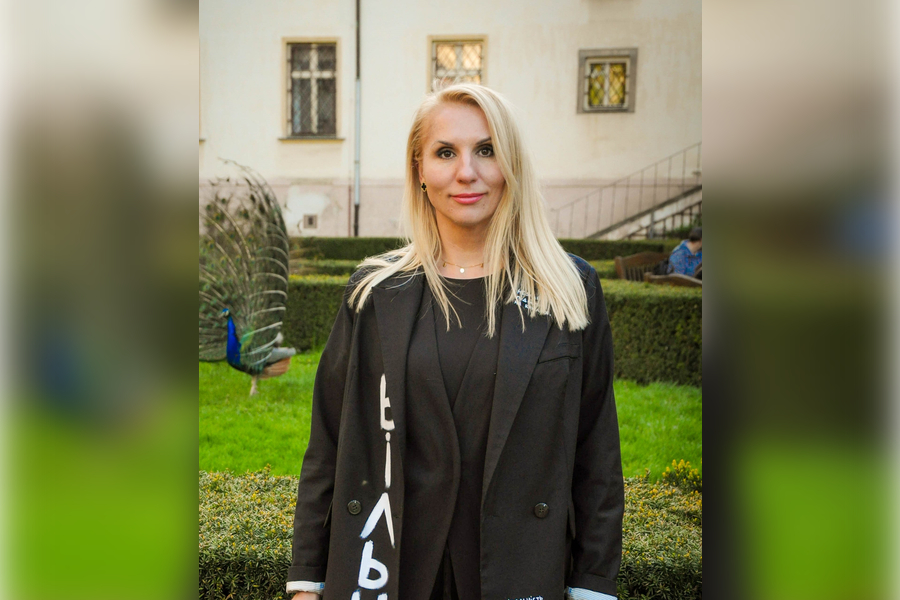 Dr Valeria Korablyova is the Head of the Research Centre ‘Ukraine in a Changing Europe’ and Assistant Professor at the Department of Russian and East European Studies, Institute of International Studies, Charles University (Prague, Czech Republic); and Affiliated Researcher at the French Research Center in Humanities and Social Sciences – Prague (CEFRES). Her expertise relates to post-Soviet transformations in Ukraine and the region, with a focus on performative politics and entangled imperial/colonial legacies. Dr Korablyova holds a habilitation (Dr of Sc degree) from Taras Shevchenko Kyiv National University. She has conducted research and taught at Stanford University, Sciences Po Lyon, University of Basel (URIS Programme), Institute for Human Sciences in Vienna (IWM), and other prominent institutions. Currently, she co-leads the CU – CNRS project ‘A Subaltern That Sings: From Sound Resistance to Musical Diplomacy in Wartime Ukraine’ (Charles University – Sorbonne University), as well as the SEED4EU+ project ‘ESCAPE: the Eurovision Song Contest as an Arena for Pluralism and Europeanness’.
Share article: