

KIUrious – Interview series
Bounded Solidarity: Poland and Ukraine amid Russia’s Full-Scale Invasion
Polish President Karol Nawrocki has taken a harder line on Ukraine: he opposes Kyiv’s NATO bid, rules out sending Polish troops under any circumstances, and has tightened domestic support for Ukrainian refugees. The country remains strongly critical of Russia, but this does not mean unlimited solidarity with Ukraine.
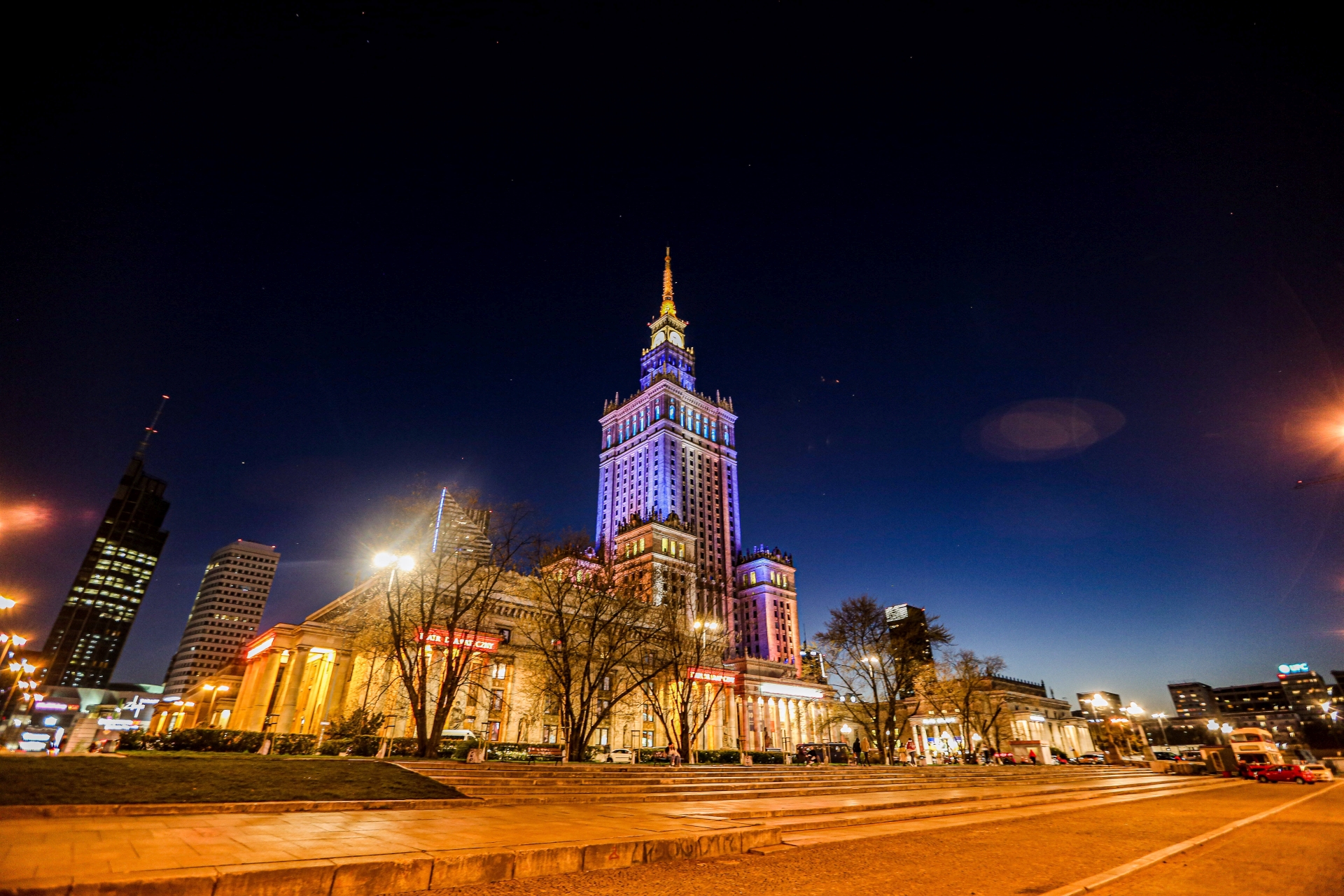 The Palace of Culture and Science in Warsaw illuminated in blue and yellow in solidarity with Ukraine, April 22, 2022 (Imago/ Zuma Press Wire).
Russian drones violated Polish airspace this autumn. How did that shift Poles’s views about Ukraine and their own security?
Above all, it showed that Poland combines harsh rhetoric against Russia with a strong focus on its own security — criticism of Russia does not automatically mean unlimited support for Ukraine.
In reaction to the drone infringement, President Nawrocki presented himself as strong and fearless saying that Poland will not be intimidated by Russian drones. Deputy Prime Minister and Foreign Minister Radosław Sikorski (Civic Coalition/ PO) called on NATO to consider shooting down Russian drones and missiles over Ukrainian territory. He later clarified that Poland could not take such action unilaterally, which gave the impression that he was bluffing before.
A similar dynamic was by the way visible in the case of Ukrainian diver Volodymyr Zhuravlov, who had been suspected by Germany of involvement in the Nord Stream 2 pipeline explosion. When a Polish court dismissed his case, Prime Minister Donald Tusk commented on X: “And rightly so. Case closed.” President Nawrocki added: “That’s how it should be.” Again, Polish leaders projected toughness towards Russia (and praised Ukrainian actions), but in ways that carried no political or military cost for Poland. It is, however, important to remember that this is not a Polish peculiarity — the fear of direct involvement applies across Europe.
Beyond the drone incident, what broader concerns shape Poland’s current stance towards Ukraine?
Poland’s security concerns include Ukraine’s potential NATO accession and the possible deployment of troops for a future peace mission. While Trump has made clear that he does not want Ukraine in NATO, Nawrocki echoed this stance in explicitly nationalist terms, saying that Polish soldiers will not die in Ukraine and will not be sent there.
I would like to emphasize one thing: given Poland’s tense relations and geographic proximity to Russia, even a minor incident involving Polish soldiers in Ukraine is seen as a potential trigger for escalation.
It is worth saying that Nawrockis position stands in contrast to Prime Minister Tusk, a liberal, who in 2024 argued that Ukraine’s NATO membership would strengthen security across Europe. More recently, however, Tusk has preferred to focus on Ukraine’s EU accession rather than address the NATO question directly.
What factors drive Poland’s cautious approach to NATO’s role in the war?
There are still echoes of the old debate about NATO’s eastward expansion around — whether it provoked Russia’s decision to invade Ukraine, as historians like Jonathan Haslam have argued. This has regained urgency as the United States shifts its strategic focus away from Europe toward the Pacific, forcing European countries to reconsider their own security and alliances.
Given these circumstances, debates continue over how far Poland and NATO should go in confronting Russia and supporting Ukraine. Some, like Szymon Hołownia, Marshal of the Sejm from 2023 to 2025, claimed that ‘we’ll crush Putin into the ground’, without clearly indicating what is meant by that. Others, like the philosopher and popular left-wing public intellectual Paweł Mościcki, ask whether such threats lead to anything constructive and wonder:
‘Do we really want hypersonic missiles to start flying over our heads instead of just mock drones made of foam?’
The ambivalence — verbal defiance toward Russia and practical restraint toward Ukraine — seems to go beyond current politics. Where does it stem from?
Poles have grown up seeing conflict with Russia as something almost natural — it is part of what has been passed down from generations who fought against communism, the USSR, Stalinism, and Bolshevism. Polish philosopher Mikołaj Ratajczak argues that, since 1989, the only ideology that consistently unites almost all political forces in Poland is a broadly shared anti-communist outlook.
Polish politicians rhetorically exploit the generational fear and contempt toward Russia to score political points and shut down debate on matters of war and peace. At the same time, the right — including Nawrocki — as well as liberals such as Sikorski, emphasize that Ukraine’s accession to the EU depends on its recognition of the Volhynia massacres. Nawrocki and Sikorski frame this not as a political matter but as a ‘civilizational’ one, arguing that only states capable of coming to terms with their own past can join the EU.
Foreign policy is only one part of the picture. President Nawrocki vetoed the extension of the Ukraine aid law, the legal framework regulating the protection status and social benefits of Ukrainians in Poland, and later allowed a tightened version to pass. What was this decision about?
During his presidential campaign in February 2025, Nawrocki stated that Ukrainians living in Poland should not enjoy better living conditions than Polish citizens. Once in office, he vetoed the initial extension of support and later approved a tightened version of the law that linked child benefits to parental employment and tax payments, with only a few defined exceptions. Non-working parents also face limits in access to healthcare.
Importantly, this shift was not Nawrocki’s idea alone. His liberal rival in the campaign, liberal Warsaw mayor Rafał Trzaskowski, had earlier proposed conditioning the Family 800 programme on employment. Nawrocki’s final version largely mirrored that proposal, indicating that the move toward more restrictive rules cut across party lines rather than being driven solely by him. Nawrocki said that next year, unless significant changes are made, he will not sign the bill extending aid for Ukraine. The current bill remains in force until March 2027.
How do you explain President Nawrocki’s shifting position?
This back-and-forth has to do with the internal conflict between Tusk and his Civic Coalition on the one hand, and Kaczyński, Nawrocki, and PiS on the other — a conflict sharpened by the growing influence of Konfederacja, a far-right, anti-EU and openly anti-Ukrainian party that has been pulling the political debate to the nationalist right. Nawrocki wants to show that, as president, he is the one taking the initiative. He also wants to signal to voters with anti-Ukrainian sentiments that he is willing to tighten support measures.
What impact do these changes have on Ukrainians living in Poland?
For Ukrainians in Poland, the changes bring little immediate impact and only minimal savings for the state budget, as OECD data show that around 80% of Ukrainians residing in Poland are already legally employed. However, Nawrocki’s position is part of a broader European trend — not something unique to Poland.
So this is not only a sign of growing hostility toward migrants. It also reflects a broader mechanism of channeling social frustration: migrants — particularly Ukrainians in Poland — are turned into scapegoats for problems rooted in underfunded healthcare, a shortage of public housing, and the lack of childcare facilities. These debates express deeper anxieties triggered by the erosion of welfare states, the fear of war, and governments’ attempts to balance national budgets in economies increasingly shaped by investment in the arms industry. For now, the practical changes remain limited — but this may not last. When conditions tighten, it will be the most vulnerable groups, migrants included, who will feel the impact most severely.
Expert: Dr Waldemar Rapior, sociologist; KIU Fellow, explores how Polish and Ukrainian activists build cross-border solidarity – and the role of civil society networks in times of war and rising nationalism
Interview: Belinda Nüssel, Competence Network Interdisciplinary Ukrainian Studies (KIU) Frankfurt (Oder) – Berlin, Research Communication Officer